
NextREVIEW · Movies. Ideas. A better you.
Edison Force (2005): Finding the Truth Before Telling the Story
Some movies stay with us because of their spectacle. Others stay because they remind us of something we were taught—and challenge us to keep living by it.
Edison Force brought me back to my days as a high school journalist, learning under Sir Dyun Perdigon, and later to my years working in broadcast media. The responsibility to be accurate. To be fair. To make a story compelling without sacrificing the facts.
May mga pelikulang kahit mabagal ang takbo, may mensaheng tumatama sa personal mong experience. This was one of those films for me.
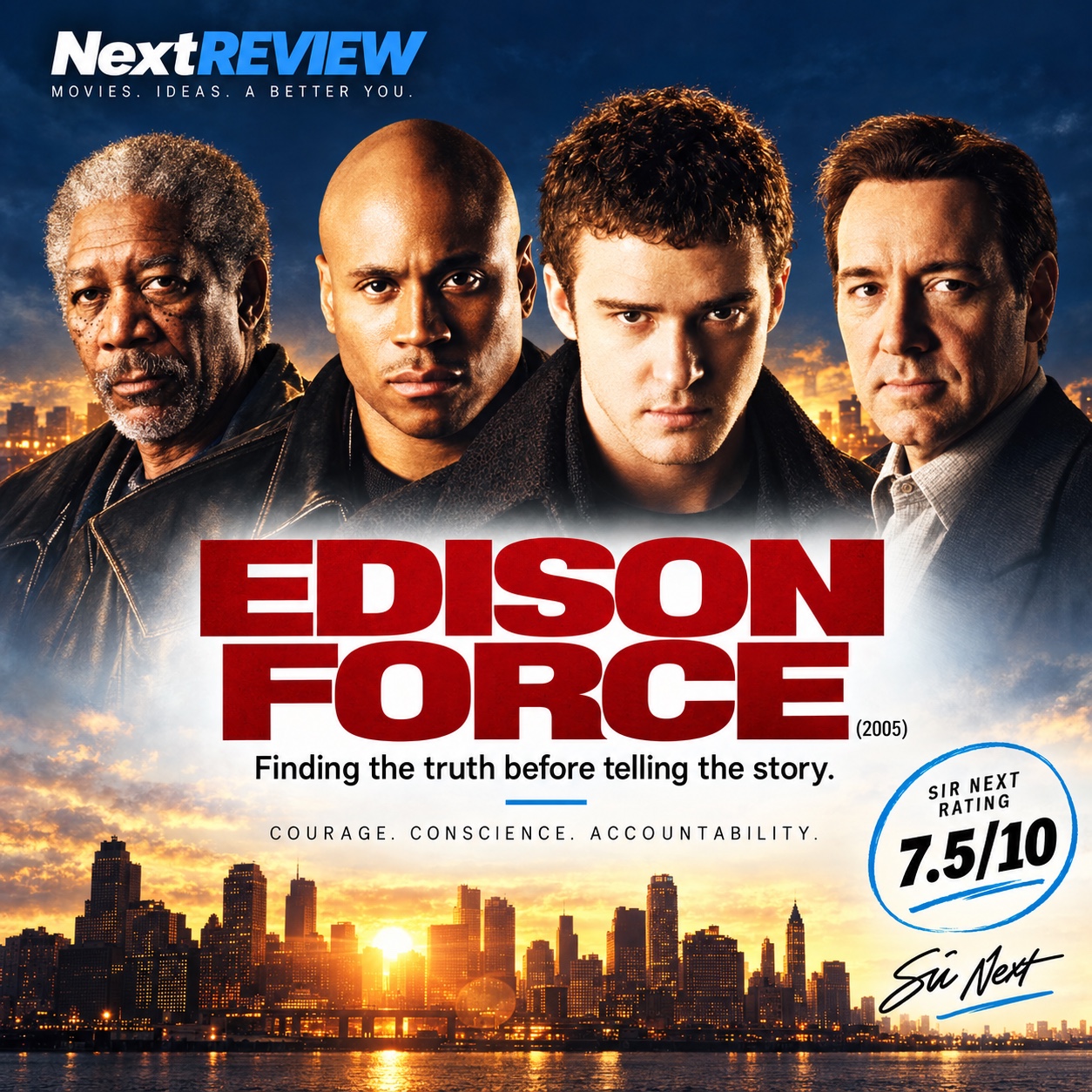
This review discusses the story and its ending. Sir Next’s rating reflects his personal assessment of the film.
The story
Written and directed by David J. Burke, Edison, also released as Edison Force, follows Joshua Pollack, a young reporter who notices something suspicious during a criminal trial. That inconsistency leads him toward F.R.A.T., an elite police unit whose public authority conceals serious criminal activity.
His editor, Moses Ashford, initially refuses to publish his accusations without evidence. But what appears to be discouragement becomes an important lesson: suspicion may start an investigation, but it cannot substitute for reporting.
With Ashford’s guidance, Levon Wallace’s assistance, and information from conflicted officer Raphael Deed, Pollack discovers that the corruption extends beyond individual policemen. As he gets closer to the truth, both he and the people around him face increasingly dangerous consequences. See the film’s official synopsis.
The central question becomes: How do you expose wrongdoing when the people entrusted to uphold justice are implicated in it?
The characters and performances
Justin Timberlake as Joshua Pollack
Pollack’s impatience gives the story its momentum. He recognizes something troubling, but initially lacks the discipline to build a defensible case. Timberlake’s performance can feel uneven, yet that youthful restlessness fits a reporter still learning the difference between conviction and proof.
Morgan Freeman as Moses Ashford
Freeman provides the film’s steady center. What I appreciated most was how Ashford pushes Pollack to investigate, verify, and earn the story he wants to tell. His mentorship gives the film its most meaningful relationship.
LL Cool J as Raphael Deed
Deed carries its strongest moral conflict. He belongs to the corrupt unit, but his conscience increasingly resists it. His struggle raises a difficult question: once you have participated in wrongdoing, what will it cost to change direction?
Kevin Spacey as Levon Wallace
Wallace brings an experienced investigator’s caution to Pollack’s urgency. His presence helps show that uncovering institutional corruption requires allies who understand how the system operates.
Dylan McDermott as Francis Lazerov
Lazerov embodies intimidation and brutality. Alongside John Heard’s Captain Brian Tilman and Cary Elwes’s District Attorney Jack Reigert, he represents different layers of the power structure Pollack confronts. Cast and crew reference.
What the reviews say
The film received a harsh critical reception. When checked for this review on October 11, 2026 (Philippine time), Rotten Tomatoes listed an 11% Tomatometer from nine reviews and a 36% audience score. These figures may change.
I can understand the criticism. The pacing feels slow in places, some characters lack depth, and the later action sometimes overwhelms the investigative story that interested me most. Still, my personal connection to its journalism and mentorship themes made it a more worthwhile watch than those numbers might suggest.
What I took from it
1. A compelling story must be able to stand on its facts.
This was my strongest takeaway. Ashford makes Pollack work for the truth. He challenges him to move beyond an instinct and gather evidence that can withstand scrutiny.
That reminded me of my early journalism training. A powerful headline carries responsibility. So does every detail beneath it.
Hindi sapat na maganda ang pagkakasulat. Kailangang mapanindigan ang katotohanan nito.
2. Fairness requires honest examination.
My journalism training and experience in broadcast media taught me to value balance, accuracy, and context. For me, balanced reporting means examining the evidence fairly, giving people a meaningful opportunity to respond, and allowing verified facts to determine the story.
It also means looking beyond the convenient version of events. Who has been heard? Who has been overlooked? What information is still missing?
3. Good mentors develop judgment.
What I liked about Freeman’s character was his willingness to correct Pollack. Sometimes, the most useful mentor is the person who tells us our work is not ready—and then helps us understand what it needs.
Sir Dyun Perdigon’s training came to mind because those early lessons helped shape how I understood journalism. Techniques matter, but the standards we learn can stay with us throughout our working lives.
4. Corruption survives through cooperation and silence.
The film portrays wrongdoing sustained by a network of people protecting one another. That makes accountability a leadership issue. What conduct do we tolerate? What concerns do we dismiss? What happens to the person who asks an uncomfortable question?
A system’s integrity depends partly on how it responds when someone challenges it.
5. Courage needs discipline.
Pollack’s determination matters, but so do evidence, preparation, and the people helping him. Speaking up responsibly requires care for sources, colleagues, and others who may bear the consequences.
Tapang matters. So does doing the work.
From a Christian perspective
Watching Edison Force, I thought about Micah 6:8 and its call to act justly, love mercy, and walk humbly with God. Those principles belong together.
Justice calls us to confront wrongdoing. Mercy reminds us to consider the people affected. Humility requires us to examine our own assumptions and motives.
For a Christian communicator, the pursuit of truth also demands honesty about what we know, what we can prove, and what remains uncertain.
Romans 12:21 offers another meaningful lens: overcoming evil with good. I appreciated the film’s movement toward resisting corruption, although its violent resolution is not a model I would carry into Christian life.
The moral lesson I take from it is the decision to stop cooperating with evil and begin accepting responsibility.
Its ending also complicates the sense of victory. Some threats are defeated, but accountability remains incomplete. That distinction matters: escaping a corrupt system does not necessarily mean that everyone responsible has faced justice.
A line to reflect on
“Justice is a lot like journalism. Sometimes the most important questions are the ones you decide not to ask.”
— Joshua Pollack (Justin Timberlake), Edison / Edison Force
It is a memorable line—and an uncomfortable one. I read it as an invitation to think about discretion, trust, and the consequences of disclosure. But I would be careful about treating it as permission to avoid difficult questions.
There are questions we withhold to protect someone’s dignity or safety. There are also questions we avoid because the answers might threaten our comfort or relationships.
Magkaiba iyon. And we need the honesty to recognize which one we are doing.
The Sir Next take
That is why Ashford’s mentorship mattered so much to me. He helps Pollack become more responsible with the truth he is pursuing.
From my high school journalism days to my years in broadcast media, that responsibility remains meaningful: tell the story clearly, examine it fairly, and make sure the facts can support it.
NextREVIEW verdict
Edison Force is an uneven crime thriller with a meaningful core. Its slow stretches and conventional action limit its impact, but the relationship between Ashford and Pollack gives it something worth reflecting on.
For me, the satisfaction came from seeing conscience and courage push back against corruption—even as the ending left questions about the completeness of justice.
Sir Next rating: 7.5/10
A worthwhile watch for its reflections on journalism, mentorship, conscience, and accountability. Its execution has weaknesses, but its central lesson stayed with me: before we tell a powerful story, we must do the work to establish its truth.
When telling the truth becomes inconvenient, how do we remain faithful to it?
— Sir Next
Good stories spark better thinking.
About the author
Nestor “Sir Next” Layderos is a Filipino marketing strategist, professional speaker and consultant. His NextREVIEW reflections connect films with work, leadership, faith and society. Get to know Sir Next or explore more NextREVIEW entries.
What did you think?
React anonymously. No sign-in needed.
Loading reactions…
Share on Facebook
Loading comments…