

Daily Devotion · Day 331 · Friday
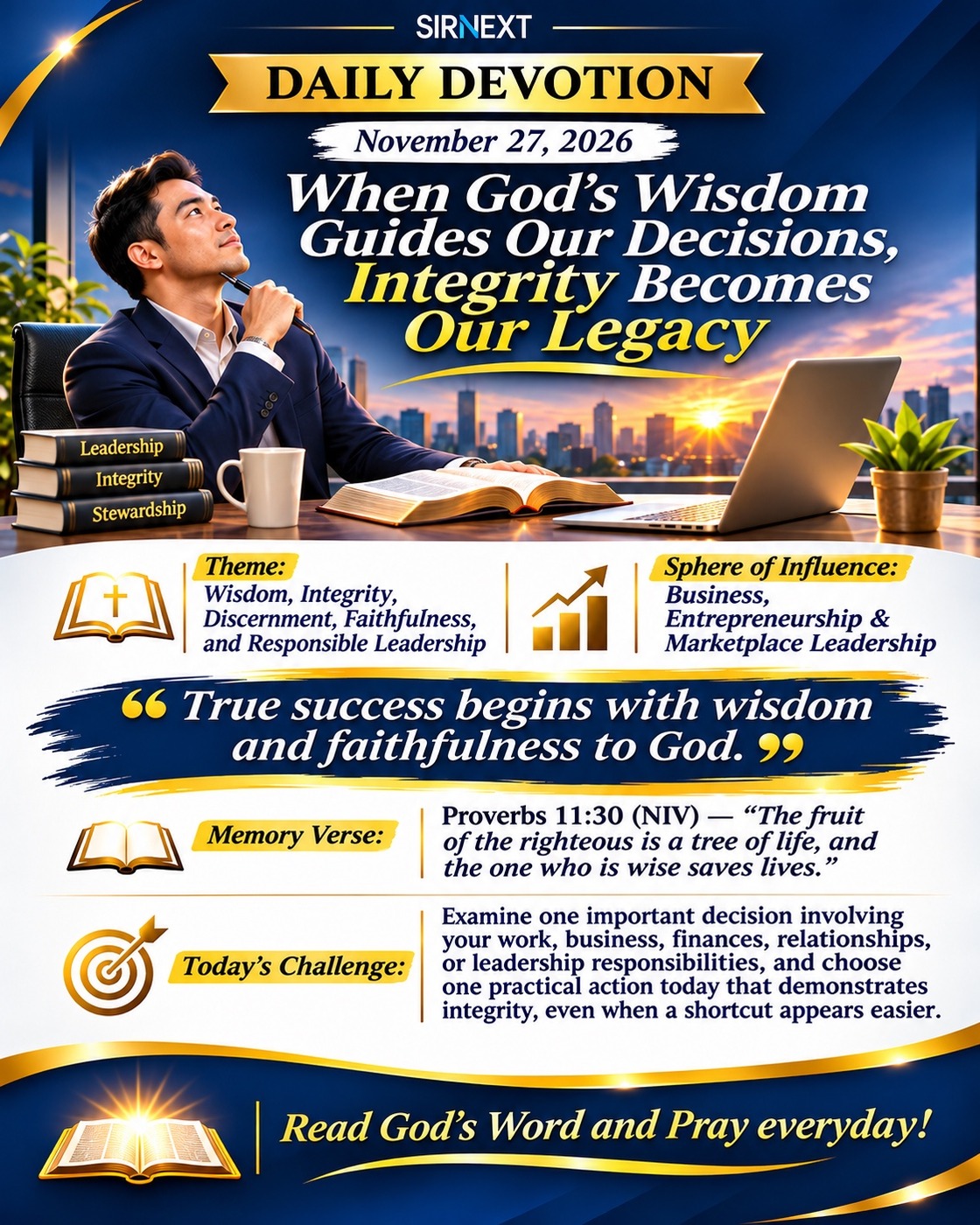
When God’s Wisdom Guides Our Decisions, Integrity Becomes Our Legacy
Read God’s Word
- Old Testament
- Psalms 119–124
- New Testament
- John 2
- Proverbs
- Proverbs 11:26–31
- Psalms
- Psalm 48
Insight
True Success Begins With Wisdom and Faithfulness to God
Every day, we make decisions that shape our future.
Some decisions involve finances, professional opportunities, business partnerships, or leadership responsibilities. Others concern our relationships, personal values, and the commitments we make when no one is watching.
In a world where success is often measured by recognition, influence, wealth, and accomplishments, Scripture reminds us that the quality of our decisions matters just as much as the results we achieve.
Success without integrity may attract attention, but faithfulness to God creates a legacy that can endure beyond our lifetime.
In Psalms 119–124, we discover the importance of depending on God’s Word for direction, strength, and protection.
Psalm 119 emphasizes the transforming power of Scripture. God’s Word is not merely a collection of religious teachings; it provides wisdom for everyday living.
Psalm 121 reminds us that our help comes from the Lord, the Maker of heaven and earth. Whatever responsibilities we carry, we are never expected to face life’s uncertainties without His guidance.
Psalm 123 illustrates humble dependence upon God, while Psalm 124 acknowledges that deliverance ultimately comes from Him.
Together, these psalms teach us that spiritual maturity begins when we recognize our limitations and seek God’s direction.
In John 2, we encounter two significant events in the ministry of Jesus.
At the wedding in Cana, Jesus transforms water into wine, revealing His glory and demonstrating His authority.
Later, Jesus confronts commercial activities taking place in the temple courts, challenging practices that had compromised the sacred purpose of His Father’s house.
These events reveal important truths about God’s provision, divine authority, and the responsibility to honor what is sacred.
For business owners, executives, entrepreneurs, and professionals, the cleansing of the temple offers a serious reminder:
Not everything that generates revenue is necessarily right, and not every profitable opportunity deserves our participation.
Proverbs 11:26–31 emphasizes generosity, righteousness, wise conduct, and the consequences of our choices.
These verses challenge us to consider how our actions affect other people.
Are we creating opportunities or exploiting vulnerabilities?
Are we using our influence to serve or merely to advance ourselves?
Are our professional decisions consistent with the values we publicly profess?
Psalm 48 celebrates God’s greatness and faithfulness. It reminds believers that God remains their guide, even to the end.
When these readings are considered together, one principle becomes clear:
Godly wisdom is demonstrated not only by what we know, but by how faithfully we apply His truth to our decisions.
For marketplace leaders, integrity should never be treated as a marketing strategy.
It must become a personal conviction.
A business may be remembered for its innovations, products, or achievements. But a leader’s lasting influence is often measured by the people they have helped, the trust they have protected, and the principles they refused to compromise.
God does not call us merely to become successful.
He calls us to become faithful.
A fictional inspirational story
The Entrepreneur Who Chose Integrity Over a Lucrative Contract
Fictional Story Inspired by Real-Life Business and Leadership Experiences
Daniel was a young entrepreneur who had spent several years building a technology consultancy.
His company was growing steadily, but financial pressures remained.
Employee salaries, operating expenses, and commitments to clients required careful management.
One afternoon, Daniel received an invitation to participate in a major technology project.
The proposed contract was worth more than his company’s annual revenue.
Winning it could provide financial stability, create new employment opportunities, and position his business for expansion.
During the negotiation, however, a representative suggested that certain project costs should be inflated to accommodate an unofficial commission.
Daniel immediately understood the implication.
If he agreed, his company could secure the contract.
If he refused, he might lose the opportunity entirely.
That evening, Daniel reviewed the proposal and prayed.
He remembered the principles his parents had taught him and the Scriptures he had studied about honesty, justice, and faithful stewardship.
He also thought about his employees.
Would rejecting the opportunity place their livelihoods at risk?
The decision was difficult.
The following morning, Daniel informed the prospective client that his company would gladly participate in a transparent and properly documented transaction, but would not agree to inflated costs or undisclosed commissions.
The negotiations ended.
For several weeks, Daniel questioned whether he had made the right decision.
Business remained challenging.
But he continued serving his existing clients, improving his services, and building relationships based on trust.
Months later, one of those clients recommended his company to an organization seeking a technology partner with a strong reputation for ethical practices.
The resulting project was smaller than the original opportunity, but its terms were fair, transparent, and sustainable.
More importantly, it opened the door to a long-term professional relationship.
During a team meeting, Daniel shared what he had learned.
“We cannot control every opportunity that comes our way. But we can decide what kind of company we are becoming.”
He realized that the greatest benefit of choosing integrity was not the possibility of receiving another contract.
It was the peace of knowing that he had remained faithful to his convictions.
His experience illustrated an important lesson:
Integrity is not a guarantee of immediate financial reward. It is a commitment to doing what is right, regardless of the outcome.
Final Reflection
As I reflect on today’s readings, I am reminded that every responsibility entrusted to me is also an opportunity to demonstrate my faith.
Whether I am advising an organization, developing a strategy, mentoring emerging leaders, communicating ideas, or making personal decisions, my choices must reflect the values I profess.
I do not want to measure my life only by the number of projects I complete, the recognition I receive, or the opportunities I pursue.
I want to consider whether I have honored God in the process.
There will always be situations where shortcuts appear attractive and compromises seem convenient.
But I must remember that not every open door is necessarily a door I should enter.
Discernment requires prayer, patience, humility, and the courage to walk away when an opportunity conflicts with God’s principles.
Today, I choose wisdom over impulse, integrity over convenience, and faithfulness over temporary recognition.
May my influence never become greater than my character.
And may my achievements never become more important than my obedience to God.
The legacy I want to leave is not simply that I succeeded, but that I remained faithful.
“The time is always right to do what is right.”
— Martin Luther King Jr., American Baptist Minister and Civil Rights Leader. Widely attributed quotation.
Memory Verse
Proverbs 11:30 (NIV)
“The fruit of the righteous is a tree of life, and the one who is wise saves lives.”
This verse reminds us that righteousness produces influence that can benefit others. Godly wisdom should lead to actions that nurture life, strengthen communities, and reflect God’s goodness.
Take it with you
Examine one important decision involving your work, business, finances, relationships, or leadership responsibilities. Before acting, ask yourself three questions:
- Is this decision consistent with God’s Word and my convictions?
- Will it demonstrate honesty, fairness, and responsibility toward others?
- Would I remain comfortable with this decision even if it brought no recognition or immediate reward?
Choose one practical action today that demonstrates integrity, even when a shortcut appears easier.
Remember: The decisions we make privately often determine the credibility of the influence we carry publicly.
Prayer
Heavenly Father,
Thank You for Your Word, which provides wisdom and direction in every season of life.
Forgive me for the times I have allowed ambition, pressure, fear, or personal convenience to influence my decisions more than Your truth.
Teach me to seek Your guidance before pursuing opportunities and making commitments.
Give me the discernment to recognize what is right, the humility to acknowledge my limitations, and the courage to uphold integrity even when doing so requires sacrifice.
As I carry responsibilities in business, leadership, consultancy, ministry, and my personal relationships, remind me that every opportunity is also a responsibility.
Help me become trustworthy in small matters and faithful in greater ones.
May my work create genuine value, my words communicate truth, and my decisions demonstrate fairness, compassion, and accountability.
Protect my heart from pride and the temptation to measure success only through material accomplishments or public recognition.
Above all, let my life reflect the character of Jesus Christ.
May the legacy I build bring encouragement to others and glory to Your name.
In Jesus’ mighty name, Amen.
Read God’s Word and Pray everyday!
Nestor “Sir Next” Layderos
Sir Next: Tech + Consultancy™
To God be the glory.
Scripture references: Psalms 119–124; John 2; Proverbs 11:26–31; Psalm 48 (NIV). The story of Daniel is fictional and intended to illustrate the devotional’s principles. The Martin Luther King Jr. quotation is widely attributed and should not be treated as a verified verbatim quotation without a primary source.
How did this make you feel?
Join the conversation
Share a thoughtful response. Use your name or leave it blank to comment as Anonymous. Comments are reviewed before appearing here.
Loading comments…