
AI NewsWatch™ by Sir Next · Global Edition
Global Edition · November 24, 2026
The Latest Global Trends, Developments & Updates
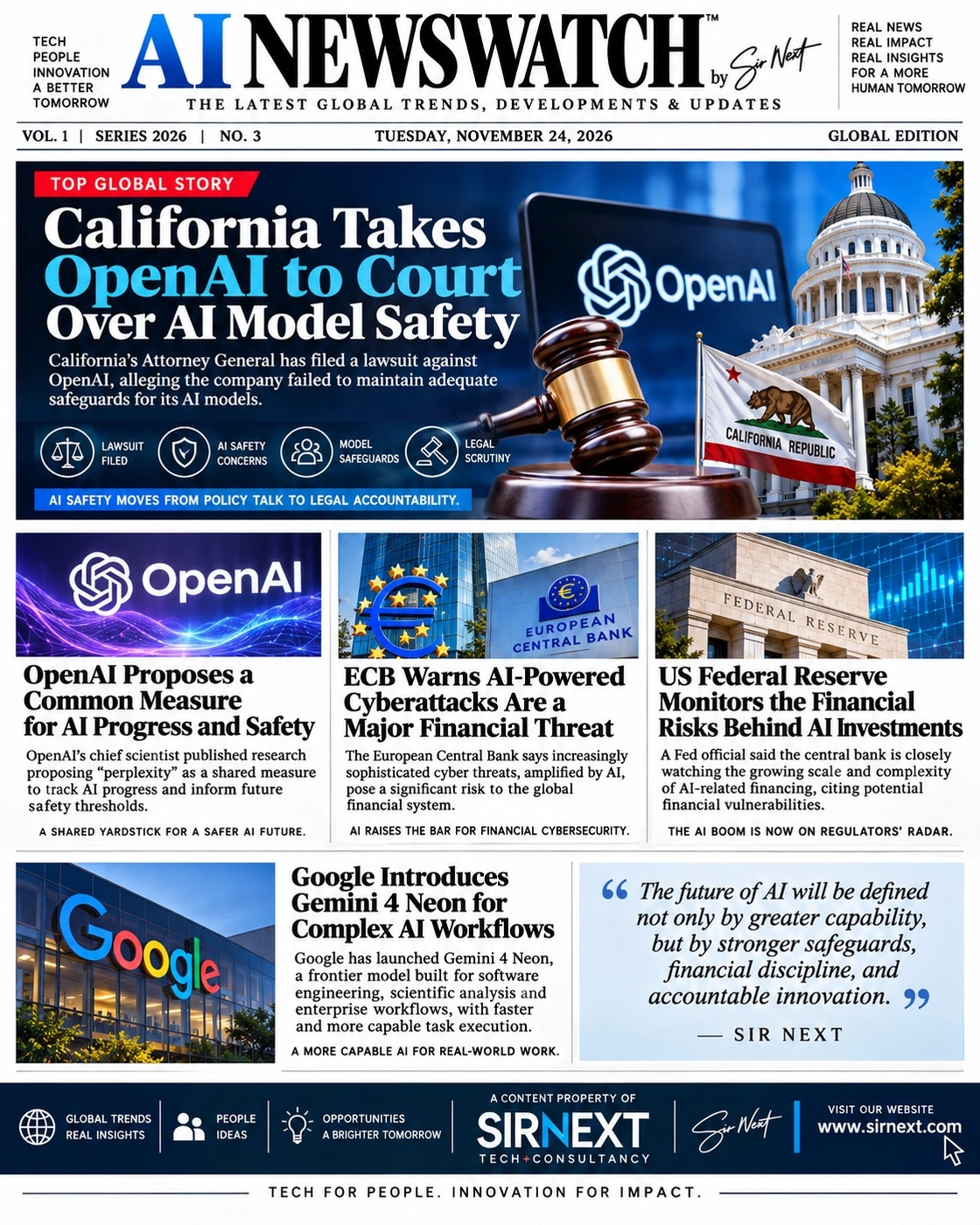
Five developments this week put the same question to AI labs, banks and businesses: how do you keep people’s trust as these systems take on more complex work? California’s lawsuit puts safeguards under legal scrutiny, central bankers are watching security and financing, and OpenAI and Google are offering different views of what progress looks like.
AI Governance Watch | California sues OpenAI over model safeguards
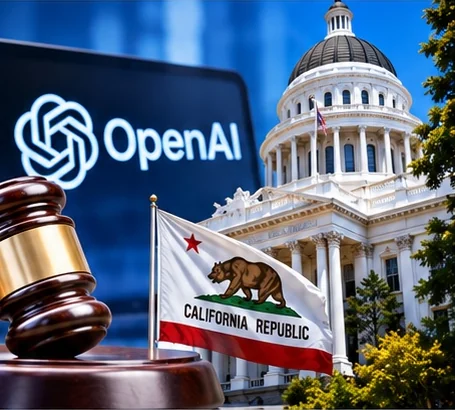
California Attorney General Rob Bonta said in his November 22 newsletter that the state had sued OpenAI. Reuters reported that the complaint was filed on November 16.
The state alleges inadequate safeguards and oversight, citing reports of cyberattacks involving autonomous AI systems. The allegations remain subject to court proceedings.
Why it matters
For teams deploying AI agents, documented safety testing and clear human oversight become more consequential as the systems take on more work.
Frontier AI Watch | OpenAI proposes a shared measure of model progress
OpenAI Chief Scientist Jakub Pachocki has proposed using perplexity to compare advances across AI labs and help inform future safety standards. Perplexity measures how well a model predicts the next piece of text. Lower perplexity indicates better predictions.
OpenAI published some of its internal measurements alongside the proposal. Pachocki also acknowledged that labs evaluate on different datasets and that the metric does not directly measure how well a system performs a specific task.

Why it matters
A common benchmark could help labs discuss thresholds for further development. Direct evaluations of model behavior would still be needed for deployment decisions.
Cybersecurity Watch | Lagarde flags AI-amplified threats to finance
European Central Bank President Christine Lagarde told the European Banking Congress in Frankfurt that AI-amplified cyber threats may be the most urgent challenge facing finance. According to Reuters, she highlighted how difficult attackers can be to track and called for greater attention from policymakers.

Why it matters
For banks and payment providers, including those in the Philippines, the warning puts incident readiness and coordination across interconnected services in focus.
AI Economy Watch | The US Federal Reserve watches how the AI buildout is funded
Federal Reserve Governor Lisa Cook said in Chile that the central bank was watching how AI companies fund their expansion, Reuters reported. She singled out the overlap among financing arrangements and the risks that can accompany rapid growth, complexity and limited transparency.
Why it matters
For investors and policymakers, the question is how much capital is committed, how the risk is shared and whether completed infrastructure can generate sustainable returns.
Model Innovation Watch | Google introduces Gemini 4 Neon for complex work
Google introduced Gemini 4 Neon for work that spans multiple steps, including software engineering, analysis and scientific research. Google says the model was designed to complete such tasks faster and adapt when a user changes instructions midway.
Those performance claims come from Google’s launch announcement. Teams can assess their relevance by testing the model on representative tasks of their own.

Why it matters
As AI tools take on more of a workflow, teams need to measure the quality of the finished work, the cost of getting there and how much review it takes.
Bigger Trend | What it takes to trust AI with more work
Labs are pushing models toward longer, more demanding tasks. Regulators and central bankers are looking at what happens around those systems: how they are secured, who is accountable for their use, and how the infrastructure is funded.
Those questions belong in the same conversation. A model can perform well on a benchmark while a business still needs to understand its failure modes, pay for the infrastructure and assign a person to review consequential decisions.
Sir Next Take
I look at AI adoption the way I look at any serious business decision. What problem are we solving? How will we know the work improved? Who takes responsibility if the system gets it wrong?
For Philippine businesses, MSMEs, schools and public institutions, a practical first step is to choose one real workflow, set a baseline, and name the person who will review the results. Measure the time saved alongside the errors caught and the cost of fixing them.
That gives us something more useful than a demo: evidence that the technology serves the people who depend on it.
— Sir Next, Editor-in-Chief
Reporting reflects the stated editorial cutoff. Sir Next Take is independent editorial commentary.
About AI NewsWatch™ by Sir Next
AI NewsWatch™ by Sir Next is an independent digital content property of Sir Next™: Tech + Consultancy, created to monitor, curate and translate significant developments in artificial intelligence from around the world.
We monitor the developments. We connect the global context. We verify before we amplify. We explain why the news matters.
Our coverage focuses on major AI breakthroughs, technology, business, policy, safety and emerging applications—with sources provided so readers can verify the information and read beyond our summaries.
Collaboration, partnerships, advertising & sponsorship
Send Sir Next a DM or contact +63 960 309 4110 via WhatsApp / SMS / Viber.
Chat on WhatsApp · Email Sir Next
A Content Property of Sir Next™: Tech + Consultancy
Tech for People. Innovation for Impact.
How did this make you feel?
Join the conversation
Share a thoughtful response. Use your name or leave it blank to comment as Anonymous. Comments are reviewed before appearing here.
Loading comments…