
NextEVENTS · Technology, Artificial Intelligence & Business Transformation
Beyond Prompting: The Growing Role of AI in Business Operations
Globe Business Breakthrough Masterclass explores agentic AI, connected workflows, responsible AI governance, and the future of human-led business transformation.
Artificial intelligence is entering a new phase of business adoption. What initially became popular as a tool for generating content, answering questions, and improving individual productivity is increasingly evolving into a technology capable of supporting entire business workflows.
For small and medium enterprises (SMEs), this development presents a significant opportunity—not simply to accomplish tasks faster, but to fundamentally improve how businesses operate, make decisions, manage resources, and serve customers.
However, an important question remains: Are businesses organizationally ready to scale artificial intelligence beyond individual productivity?
This was among the central discussions during the third and final episode of the Globe Business Breakthrough Masterclass, held virtually on November 26, 2026, with the topic “The Growing Role of AI in Business.”
I had the opportunity to participate in this learning session, which brought together perspectives on strategic AI adoption, operational transformation, enterprise technology, data governance, and human accountability.
Hosted by Sonja Calit, the masterclass featured:

Andrea Tesorero, Brand Strategy Head, Globe Business
Michelle Alarcon, President and Co-Founder of the Analytics & Artificial Intelligence Association of the Philippines (AAP) and President of Z-Lift Solutions
Martina Ingrid Giron, Business Solutions Consultant, Globe Business

The masterclass offered both strategic and practical perspectives on how Philippine SMEs can prepare for increasing demand, particularly during the holiday season, while building sustainable AI-enabled business capabilities beyond it.
Preparing Businesses for Growing Demand
Opening the masterclass, Andrea Tesorero highlighted the increasing operational demands businesses face as the Christmas and New Year seasons approach.

For many Philippine SMEs, higher customer demand translates into additional orders, inventory requirements, delivery coordination, customer inquiries, and greater pressure on employees.
While increased demand represents an opportunity for growth, it also exposes weaknesses in existing business processes.
In the previous episode of the Breakthrough Masterclass, Globe Business explored how AI could function as a marketing assistant, helping entrepreneurs translate customer insights into relevant campaigns and strengthen customer engagement.
The final episode expanded that discussion into business operations.
Rather than focusing exclusively on generating demand, businesses must also develop the operational capacity to fulfill that demand.
Tesorero emphasized that conversations about artificial intelligence must ultimately be conversations about people.
Introducing more technology is not necessarily the answer. Equipping employees with the appropriate skills, confidence, knowledge, and digital resources is equally important.
For Globe Business, this involves providing SMEs with connectivity, digital solutions, and learning opportunities that enable them to navigate technological transformation.
The opening remarks established a recurring theme throughout the masterclass: AI should strengthen human capability, not diminish human accountability.
Can AI Be Santa's Little Helper for Businesses?
Michelle Alarcon opened her presentation with a timely question: Can artificial intelligence become Santa's little helper for Philippine businesses?

While the Christmas season is often associated with celebration, relaxation, and family gatherings, it can represent one of the most demanding periods of the year for entrepreneurs.
For retailers, the holiday rush introduces several operational challenges:
Peak sales concentrated within a limited number of days.
Overstocking caused by inaccurate demand forecasts.
Unsuccessful product bundling and unsold merchandise.
Complicated promotional mechanics.
Competition from online marketplaces.
Increased seasonal staffing requirements.
Wholesale businesses face a different but equally demanding set of concerns:
Delayed collections and cash flow pressures.
Extended supplier lead times.
Limited warehouse capacity.
Inventory availability for bulk purchases.
Urgent corporate orders.
Competitive pricing and fulfillment requirements.
These challenges are not exclusive to Christmas. They reflect operational inefficiencies that many SMEs encounter throughout the year, but which become more visible during periods of heightened demand.
AI offers opportunities to address these issues, provided that businesses approach its implementation with clearly defined objectives and reliable information.
From Personal Productivity to Organizational Capability
Many entrepreneurs are already familiar with generative AI.
They use AI to develop campaign concepts, prepare promotional materials, write social media content, and support branding initiatives.
However, these activities are often performed as isolated, one-off tasks.
Alarcon explained that the next stage involves expanding AI adoption beyond the business owner or the employee who happens to know how to use AI effectively.
She outlined a progression from individual use to shared team capability and eventually to established organizational routines.
Stage 1: Individual AI Use
At this stage, the business owner personally creates prompts, identifies relevant information, and validates AI-generated outputs.
The owner knows which price lists are current, which promotional mechanics are applicable, and whether AI-generated information accurately reflects business realities.
The limitation is that the knowledge remains concentrated within one person.
When that person is unavailable, the process may also become unavailable.
Stage 2: Shared Team Capability
The second stage involves transferring AI knowledge to employees, virtual assistants, bookkeepers, and other team members.
Businesses can establish shared prompts, verified fact sheets, centralized documents, and knowledge repositories that employees can consistently access.
The objective is to ensure that one person's effective AI workflow becomes available to the rest of the organization.
Human review remains important, particularly when AI-generated outputs are intended for customers or suppliers.
Stage 3: Institutionalized AI Routines
The third stage involves transforming effective prompts into recurring business processes.
Each routine should have a designated owner, a defined schedule, approved information sources, documented procedures, decision limits, and a review mechanism.
Rather than requiring business owners to personally validate every routine output, appropriately controlled processes can eventually be monitored through periodic spot checks and exception reporting.
At this stage, AI becomes more than an individual productivity tool. It becomes an organizational capability.
Establishing a Single Source of Truth
One of the most practical issues discussed was the inconsistency of information across business teams.
Customers frequently ask similar questions about prices, promotional mechanics, product availability, delivery schedules, and order cutoffs.
Yet different employees may provide different answers.
Complicated discount mechanics, outdated price lists, and inconsistent interpretations of promotional policies can negatively affect customer experience.
Alarcon recommended establishing a reliable business fact sheet supported by standardized team prompts.
For example, an AI-assisted customer service workflow could instruct the system to respond in friendly Taglish using no more than three sentences, while relying exclusively on verified business information.
If the answer is unavailable, the system should indicate that a staff member will confirm the information rather than inventing a response.
The final message would still be reviewed by an employee before being sent to the customer.
This introduces SMEs to a fundamental data governance concept: the Single Source of Truth (SSOT).
A single source of truth does not necessarily require an expensive enterprise database. It can begin with a properly maintained spreadsheet or approved document containing current business information.
What matters is that everyone works from the same authoritative information.
Transforming One-Off Prompts into Recurring Business Workflows
The next opportunity involves converting repetitive AI activities into standardized operational routines.
Several examples were presented, including:
Daily sales and inventory summaries.
AI-assisted order confirmation messages.
Promotional deadline monitoring.
Identification of unconfirmed orders.
Low-stock alerts.
Slow-moving inventory analysis.
Replenishment recommendations.
An illustrative inventory workflow involved identifying products with fewer than five days or more than 30 days of estimated stock coverage.
For products with insufficient inventory, AI could recommend replenishment quantities intended to cover 14 days of demand.
For products with excessive inventory, it could recommend possible promotional or bundling strategies.
Such recommendations must still be evaluated against actual demand, supplier availability, lead times, cash flow, and management policies.
Alarcon also introduced the concept of an AI Routine Card.
A routine card documents the operational details of a recurring AI activity.
For example:
Routine: Monday Stock Check
Process Owner: Store Supervisor
Schedule: Every Monday, 9:00 AM
Input: POS sales extract for the previous seven days and current inventory records
Prompt Location: Approved company prompt repository
Output: Inventory alerts and proposed replenishment quantities
Review: Business owner approval before purchase orders are issued
This approach transforms an informal AI activity into a repeatable business process.
It also reduces dependency on individual employees and creates a foundation for knowledge transfer, operational continuity, and quality assurance.
Scaling Managerial Judgment Through an AI Decision Matrix
Another important discussion centered on how organizations can translate managerial judgment into documented operational rules.
Business owners often make decisions based on experience and institutional knowledge accumulated over several years.
However, employees may interpret business situations differently, particularly when decision-making boundaries are unclear.
AI can assist by evaluating requests against documented policies and identifying exceptions that require management approval.
Alarcon recommended creating a decision matrix that distinguishes between three levels of responsibility:
| Business Activity | AI Responsibility | Employee Responsibility | Management Responsibility |
| Sales quotations | Prepare drafts | Review standard quotations | Approve exceptional terms |
| Discounts | Assess against policies | Approve within written limits | Approve exceptions |
| Refunds | Evaluate policy requirements | Process authorized amounts | Approve significant refunds |
| Inventory | Identify replenishment needs | Reorder approved products | Approve unusual purchases |
| Credit terms | Consolidate supporting information | Verify requirements | Make final credit decisions |
In one example, a corporate customer requests a 12% discount.
The company's documented policy allows employees to authorize discounts of up to 5% and prohibits additional discounts on products already included in a promotion.
AI can identify that the request exceeds employee authority, recommend escalation, and remind employees to confirm inventory availability before issuing a quotation.
What AI cannot independently do is authorize an exception or make a binding commercial commitment.
This illustrates an essential principle of responsible AI implementation: decision-making can be supported by technology without transferring ultimate accountability away from humans.
Data Standardization: Why AI Needs More Than Information
Alarcon further explained that successful AI adoption requires consistent business definitions and standardized records.
Using a one-kilogram Queso de Bola as an example, she illustrated how the same product could appear under different names, product codes, and prices across retail stores, warehouses, financial records, and online selling platforms.
AI can compare these records, identify potential matches, highlight discrepancies, and propose a master product record.
However, employees or authorized managers must confirm whether those records genuinely refer to the same product.
A similar concern arises when departments use identical terminology to describe different business concepts.
For example, the word price could refer to:
Standard list price.
Promotional selling price.
Net selling price after discounts.
Online marketplace price.
Product acquisition cost, if incorrectly labeled as price.
These values cannot be treated interchangeably.
The business must define each data field clearly so that AI can interpret information consistently.
From an enterprise technology perspective, this discussion introduces the importance of Master Data Management (MDM), data dictionaries, information ownership, version control, and data quality management.
AI is only as useful as the business information and definitions upon which its outputs are based.
The Six AI House Rules
Rather than introducing SMEs to complex AI governance terminology, Alarcon presented a practical concept: welcoming AI into the business with clearly established house rules.
These six rules can serve as an initial foundation for responsible AI adoption.
1. Define what AI is allowed to do independently.
AI must operate within clearly defined responsibilities. It should not independently make payments, issue binding promises, or enter into unauthorized business commitments.
2. Identify which decisions require human approval.
Exceptional discounts, credit terms, significant refunds, and other consequential business decisions must remain subject to appropriate authorization.
3. Specify information that must not be uploaded.
Businesses should clearly identify sensitive information that employees are prohibited from sharing with unauthorized AI tools, including passwords, identification documents, financial credentials, and sensitive customer information.
4. Establish where authoritative business information resides.
Maintain reliable price lists, inventory sheets, promotional rules, and business policies with designated information owners.
5. Assign responsibility for reviewing AI-generated outputs.
A named employee or authorized manager should validate relevant communications before they are released to external stakeholders.
6. Establish an error correction and improvement protocol.
When AI produces incorrect results, the organization should have a defined process for correcting the output, revising instructions, documenting changes, and preventing recurring errors.
These house rules make AI governance accessible even to businesses without sophisticated corporate compliance structures.
Alarcon also distinguished activities that may reasonably be delegated to AI from those that should remain under human responsibility.
AI can assist with routine data entry, record matching, sorting, report drafting, and payment reminder preparation.
Negotiations, sensitive complaints, credit approvals, and important customer or supplier relationships require human judgment and accountability.
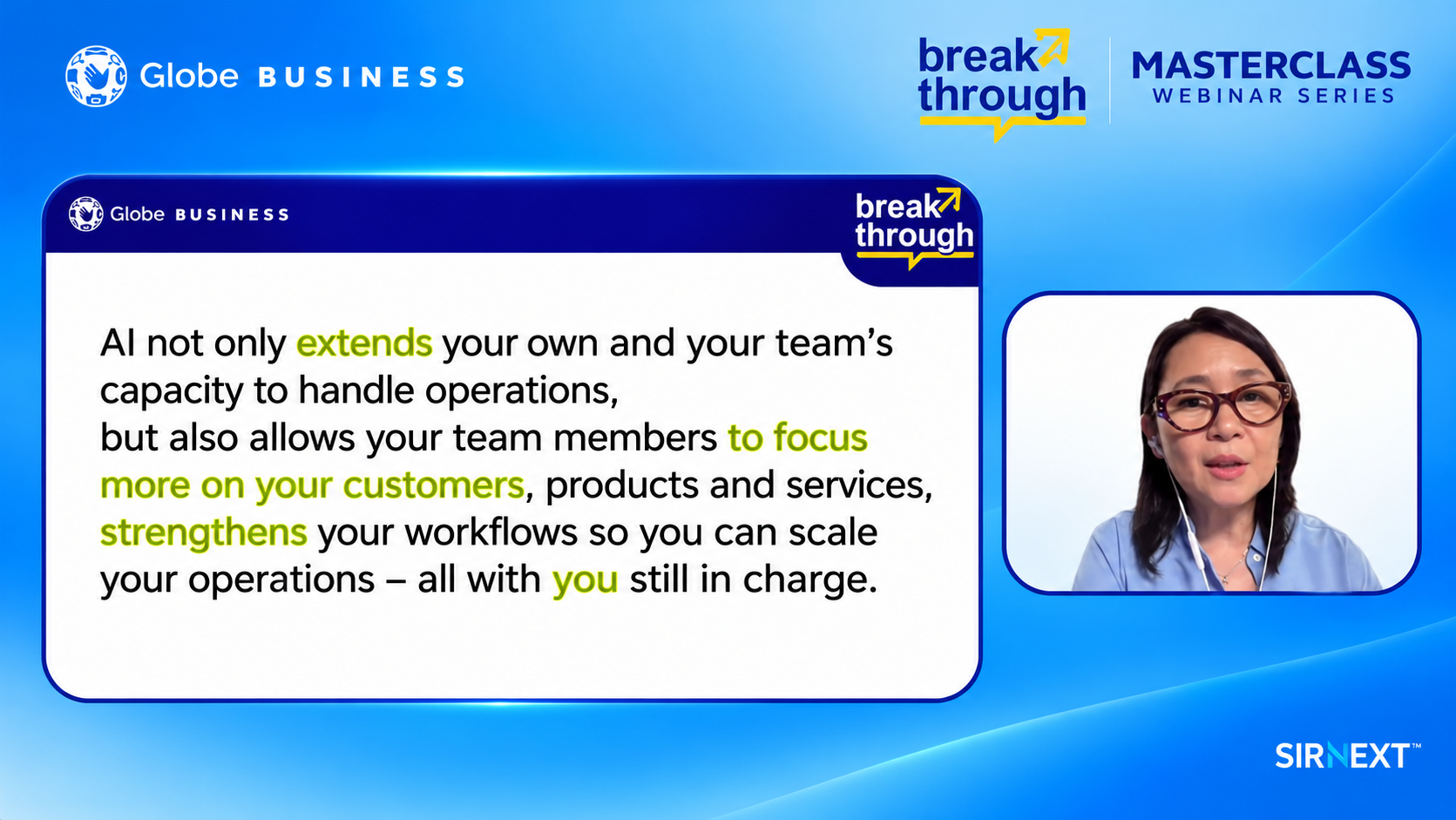
Her presentation concluded with an important reminder: AI should extend organizational capacity while enabling employees and business owners to concentrate on customer relationships, product improvement, service quality, and other meaningful activities.
Beyond Generative AI: The Rise of Agentic AI
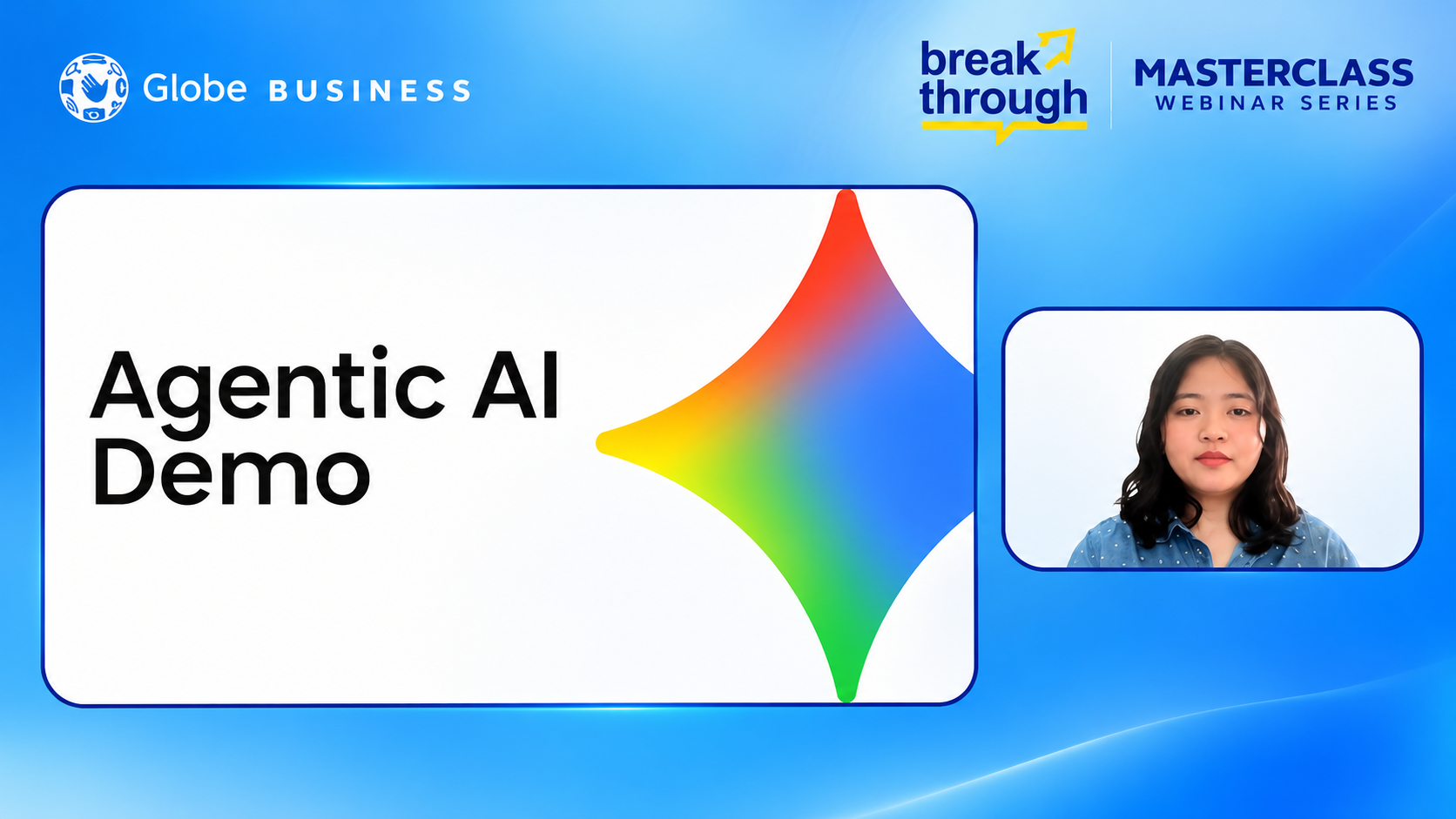
The second presentation shifted the masterclass from strategic management principles to practical enterprise technology.
Martina Ingrid Giron introduced Gemini Enterprise, an agentic AI solution offered through Globe Business, demonstrating how connected applications and specialized AI agents can support everyday operations.
While generative AI is widely associated with content creation, summarization, and conversational assistance, agentic AI introduces an additional capability: coordinating multiple actions toward an assigned goal.
Rather than requiring employees to specify every application and every step, an appropriately configured AI agent can identify the tools and information needed to accomplish an objective.
| Conventional AI Assistance | Agentic AI |
| Responds to individual instructions | Works toward defined objectives |
| Generates content and summaries | Coordinates multiple workflow steps |
| Primarily supports individual tasks | Can support organizational processes |
| Often requires explicit tool instructions | Can select available tools according to context |
| Usually initiated through prompts | Can support scheduled workflows |
These categories are not mutually exclusive. Agentic systems frequently use generative AI models as their underlying intelligence.
The distinguishing capability is the orchestration of reasoning, context, applications, and actions within defined permissions and operational boundaries.
Giron described AI agents as functioning somewhat like a digital chief of staff, coordinating available tools and information to support operational execution.
Connected Applications and Enterprise Grounding
An important aspect of the demonstration was the integration of AI with enterprise applications.
Giron discussed connections to platforms such as Google Workspace, Microsoft services, Salesforce, Jira, and Confluence.
The objective is to reduce the need for employees to repeatedly download files, switch applications, upload documents, and manually consolidate information.
Through authorized connectors, an AI platform can retrieve relevant enterprise data directly and use that information as context for business tasks.
This capability is commonly associated with enterprise grounding—supporting AI responses with relevant organizational information rather than relying exclusively on general model knowledge.
Connected applications can also reduce certain risks associated with manual file transfers.
However, integration does not automatically guarantee security. Organizations must still maintain appropriate permissions, information classification, monitoring, and governance.
Exploring the Gemini Enterprise Interface

During the live demonstration, Giron introduced several features available within the platform environment she presented:
Conversational AI for everyday business tasks.
A library for accessing previously generated materials.
Projects for organizing related work.
Skills for saving reusable instructions.
Agents for coordinating specialized workflows.
Connections to enterprise files and applications.
Internal company data search.
Web research and deep research capabilities.
Integrated document and presentation development.
Multimodal content generation.
Model selection based on the nature of a task.
The discussion also highlighted the importance of selecting appropriate AI models according to business requirements.
Routine information processing may benefit from faster models, while complex analytical tasks may require models with stronger reasoning capabilities.
This is particularly important when considering resource efficiency and the financial sustainability of enterprise AI adoption.
Live Case Study: The Unique Clothes Inventory Agent
To demonstrate how agentic AI can support real-world operations, Giron presented a business scenario involving a company called Unique Clothes.
The demonstration business operates five physical branches and an online store, with inventory requirements coordinated through a warehouse.
Its operational challenge involves employees repeatedly checking emails, extracting restocking requests, updating inventory trackers, and revising records whenever new information arrives.
This repetitive process increases employee workload and creates opportunities for errors, particularly during the Christmas season.
The demonstration established three primary objectives:
Automated Restock Intake — Consolidate branch inventory requests from different emails and relevant documents.
Proactive Inventory Monitoring — Identify replenishment needs based on established inventory thresholds and business information.
Warehouse Dispatch Coordination — Consolidate branch requirements and prepare warehouse communications for review and execution.
Before creating the agent, Giron reiterated a principle raised earlier by Alarcon: businesses must first understand the problem they intend to solve.
The technology should support the process, not define the business problem.
How a Context-Aware Inventory Agent Works
The inventory agent was previously provided with information about the relevant spreadsheet, inventory rules, email sources, and operational responsibilities.
Instead of repeatedly explaining where the data was located, Giron asked a straightforward question:
Is my tracker currently updated? Do I have new items I need to add?
The agent interpreted the request, identified the relevant tracker, and delegated spreadsheet examination to a specialized file analysis capability.
The inventory spreadsheet contained operational fields such as:
| Data Field | Business Purpose |
| Sales channel | Identify branches and online operations |
| SKU | Product identification |
| Item description | Product reference |
| Daily run rate | Estimated daily sales volume |
| Current on-hand inventory | Stock availability |
| Safety stock | Inventory buffer |
| Lead time | Replenishment planning |
| Unit cost | Cost management |
| Restock status | Inventory monitoring |
The agent's initial result indicated that all ten active SKUs were already represented in the inventory tracker, with no additional items identified at that point.
This demonstrated how a simple natural-language request could initiate a more complex workflow involving information retrieval, spreadsheet analysis, and operational reconciliation.
Giron also showed how the platform displayed aspects of its execution process, allowing users to observe which tools were being used.
Such visibility supports traceability, although it does not eliminate the need to verify the accuracy of AI-generated conclusions.
Intelligent Email Search and New Restock Requests
The demonstration then introduced a new operational scenario: additional restocking requests arriving from branch managers.
Giron instructed the agent to check incoming emails for new stock requests.
Rather than relying exclusively on exact keyword matching, the system attempted to interpret relevant communications even when they used different email formats, subject lines, and terminology.
It also examined connected Google Drive information for relevant documents.
The agent identified two incoming restock requests involving the Makati and Cagayan de Oro branches.
It consolidated relevant information, including product descriptions, SKUs, requested quantities, and delivery considerations.
The demonstration also showed links to the original source emails, enabling employees to examine the underlying communications.
This represents a practical application of semantic search, enterprise grounding, information extraction, and AI-assisted operational intelligence.
From Information Retrieval to Business Execution
The next step involved preparing a consolidated email for warehouse coordination.
The inventory agent used the retrieved information to prepare a draft containing the proposed recipients, subject, and message content.
Giron demonstrated how the draft could be edited directly within the platform before sending.
This capability illustrates a broader shift in AI adoption.
Instead of simply receiving an answer from AI and manually transferring it to another application, users can potentially coordinate multiple stages of a business workflow within a connected environment.
Nevertheless, Giron retained human control over the final communication.
The employee could examine the proposed recipients, verify replenishment requirements, revise the message, and authorize its transmission.
The demonstration reinforced the human-in-the-loop principle discussed earlier in the masterclass.
AI may support information retrieval, analysis, recommendation, and communication preparation. Humans remain responsible for validating consequential decisions and commitments.
Building a Custom AI Agent Through Natural Language
Giron subsequently demonstrated how a specialized agent could be created without requiring the user to manually develop every component from scratch.
By providing a general objective—such as creating an inventory and restocking agent capable of examining relevant emails and business files—the platform generated an initial agent configuration.
The generated configuration included proposed instructions, tools, knowledge requirements, and expected outputs.
However, the initial configuration still required human review and refinement.
The agent was expected to:
Analyze relevant inventory information.
Produce accurate, context-grounded responses.
Summarize findings clearly.
Identify discrepancies and potential errors.
Recommend appropriate restocking actions.
Support proactive inventory monitoring.
Additional configuration options allowed users to select AI models, authorize application connectors, attach business documents, and create reusable prompts.
Giron then tested the newly created agent by asking which items required restocking based on the inventory tracker.
The agent identified products classified under the established Critical and Reorder thresholds.
The demonstration illustrated how natural-language agent development can reduce technical implementation barriers for SMEs.
It also reinforced the continuing importance of business process design, data preparation, testing, governance, and quality assurance.
From Reactive Operations to Scheduled Automation
The final portion of the demonstration introduced scheduled AI workflows.
Rather than requiring an employee to manually initiate the same inventory check every day, Giron configured a recurring task for 9:00 AM.
The scheduled task would examine relevant incoming emails and identify inventory items that should be added to the tracker.
The schedule could also be tested without waiting for its next planned execution.
During the test, the agent searched relevant emails, identified the designated inventory file, examined supporting Google Drive information, and performed additional checks for changes or missing information.
This capability represents an important transition from reactive AI assistance toward proactive operational management.
The three original business objectives—restocking analysis, proactive monitoring, and consolidated warehouse communication—were addressed during the demonstration.
However, a successful demonstration is only an initial step. Production deployment would still require accuracy testing, reliable data pipelines, appropriate permissions, exception handling, and ongoing operational monitoring.
Giron concluded by emphasizing how agentic AI can help businesses reduce repetitive administrative work and allow employees to focus their time and energy on more valuable activities.
Interactive Learning: Organize the Workflow
Following the technical presentations, the masterclass featured an interactive activity entitled “Organize the Workflow.”
Participants were presented with operational scenarios involving four workflow steps and were challenged to arrange them in the most appropriate sequence.
Across five rounds, participants applied their understanding of operational processes, information organization, decision-making, and workflow execution.
The activity offered a practical reminder that AI implementation begins with understanding how work should be organized.
An organization cannot expect technology to consistently improve a workflow that it has not adequately defined.
Open Forum: Addressing the Real Questions of AI Adoption
The open forum expanded the discussion beyond technology demonstrations, addressing practical concerns raised by SME owners and participants.
The exchanges covered investment prioritization, scalability, data security, decision quality, employee readiness, business continuity, and customer experience.
Where should SMEs with limited budgets begin?
Asked how a small retail business should prioritize AI investments, Alarcon recommended starting with the operational challenge that causes the most persistent business pain.
For some companies, this may involve insufficient customer inquiries.
For others, the greater concern may be having too many orders without sufficient operational capacity to fulfill them.
This is an important distinction.
AI-powered marketing can generate demand, but businesses must also ensure that their inventory, order processing, supplier coordination, and customer service capabilities can accommodate that demand.
Alarcon clarified that SMEs do not necessarily need to immediately purchase expensive enterprise systems.
Existing tools such as Google Sheets and organized business documents can provide an initial foundation for AI-enabled operations.
When is a business ready to scale AI?
The discussion subsequently explored how organizations can determine whether an initial AI implementation is ready to expand into larger workflows.
Alarcon emphasized sustainability across several dimensions.
A successful AI demonstration may rely on a spreadsheet prepared specifically for the demonstration. A real business, however, requires continuously updated information.
Reliable data pipelines must therefore support the ongoing flow of operational information.
Employee training and AI policies must also remain sustainable as new staff members join the organization.
Financial sustainability is another consideration.
Businesses must understand the resources required for AI usage, including subscriptions, model selection, and consumption-based costs where applicable.
For services that use token-based billing, unnecessarily lengthy instructions and irrelevant document processing may increase costs.
Not every routine task requires the most sophisticated AI model.
The objective is to select an appropriate technology based on the complexity of the task and the business value it creates.
How can organizations manage information access and security?
Giron explained that AI security involves both organizational responsibility and platform-level safeguards.
Businesses must first ensure that employees have access only to the information necessary for their responsibilities.
Confidential payroll records, for example, should not be broadly shared with employees who have no legitimate reason to view them.
She described how enterprise AI access can be governed by existing file permissions and additional platform security mechanisms.
This relates to established information security principles such as role-based access control, data classification, and least-privilege access.
However, platform safeguards should complement—not replace—properly configured access controls and organizational accountability.
My Question: How Should SMEs Measure AI Maturity Beyond Time Savings and Cost Reduction?
One of my personal objectives in attending the masterclass was to explore artificial intelligence from a broader strategic management perspective.
Building on Alarcon's Six AI House Rules, I raised the following question during the open forum:
“From a strategic management perspective, how can SMEs assess whether they are truly ready to scale AI from individual productivity to organizational capability? Are there specific maturity indicators or KPIs that business owners should monitor beyond time savings and cost reduction?”
The question was acknowledged as having an enterprise-level perspective, while remaining equally applicable to SMEs.
Alarcon responded by challenging the assumption that frequent AI usage necessarily indicates AI maturity.
An organization may provide AI subscriptions to all its employees and experience significant increases in usage without necessarily becoming a mature or responsible AI-enabled organization.
Comfort with artificial intelligence does not automatically translate into competency, governance, or sound decision-making.
Similarly, reducing a process that previously required two weeks into an activity that takes five minutes is an impressive productivity gain.
But an important question remains: What does the business do with the information?
Alarcon illustrated this through a corporate client requesting a substantial discount.
An AI-enabled business owner could retrieve relevant information about the customer's purchasing history, payment behavior, previous orders, complaints, and commercial relationship.
This intelligence could help the business owner negotiate a more appropriate balance between discounts, profitability, and payment terms.
However, the quality of the final commercial decision remains dependent on human judgment.
AI accelerates access to information. It does not guarantee that leadership will make the right decision.
Ultimately, increased revenue, improved profitability, and stronger customer relationships result from multiple factors, including the decisions and actions taken by management.
AI contributes to those outcomes but should not receive exclusive attribution for them.
Extending the Discussion: An AI Maturity Measurement Framework
From my perspective as a technology and management consultant, Alarcon's response opens a broader discussion about how SMEs can measure organizational AI maturity.
I propose that businesses begin evaluating eight interconnected dimensions:
| Dimension | Proposed Performance Indicators |
| Operational Efficiency | Process cycle time, throughput, rework rate |
| Decision Intelligence | Decision turnaround time, outcome quality, exception resolution |
| Data Governance | Data accuracy, completeness, freshness, consistency |
| Responsible AI | AI-related errors, policy compliance, review completion |
| Workforce Capability | Employee competency, training effectiveness, workflow adoption |
| Customer Experience | Response accuracy, satisfaction, complaint resolution |
| Organizational Scalability | Workflow continuity, process coverage, key-person dependency |
| Business Value | Profitability, revenue contribution, return on investment |
These indicators represent a proposed strategic measurement framework rather than an official framework presented during the webinar.
The objective is to help organizations move beyond measuring how much AI they use and begin evaluating whether AI is contributing to stronger organizational capabilities and business outcomes.
How can AI improve communication and employee handovers?
Giron discussed the challenges of inconsistent communication formats across employees.
Different team members may describe the same business information using different expressions, document structures, or email formats.
AI can help extract relevant details and consolidate them into standardized templates, enabling employees to work with more consistent information.
She also discussed scheduled shift handovers.
For example, AI-generated summaries could be prepared at 6:00 AM and 6:00 PM to help incoming employees understand important developments, outstanding responsibilities, and relevant operational information.
This application supports knowledge transfer, communication continuity, and reduced dependency on manual handover procedures.
Can AI help businesses respond to unexpected situations?
Not every business situation is predictable.
Unexpected changes in customer orders, supplier delays, operational disruptions, and exceptional requests can occur even within well-managed organizations.
Giron explained that enterprise grounding can help employees retrieve historical records, previous resolutions, relevant company memoranda, and operational policies.
A relatively new employee facing an unfamiliar situation could use AI to locate how similar circumstances were handled previously.
This introduces the possibility of AI-enabled institutional memory.
Rather than relying exclusively on the experience of particular employees, businesses can make approved organizational knowledge more accessible.
However, historical precedents remain guidance rather than automatic justification for repeating previous decisions.
Employees must still evaluate whether past practices are appropriate for current circumstances.
How can SMEs prepare for sudden increases in demand?
During peak seasons, order volumes and administrative responsibilities may increase substantially.
Giron recommended delegating repetitive activities, such as email consolidation and order extraction, to AI-enabled workflows.
This allows employees to focus on more consequential matters, including resource allocation, inventory availability, order prioritization, and fulfillment feasibility.
AI can help classify orders according to established business criteria and available operational capacity.
Management must still determine customer commitments, commercial priorities, and appropriate responses when demand exceeds available resources.
How can leaders prepare employees for AI-enabled workflows?
Alarcon addressed concerns surrounding employee anxiety and resistance to technological change.
She suggested that organizations should approach AI as an additional capability requiring thoughtful process redesign.
One of the reasons employees become overwhelmed is that leaders often announce broad AI transformation initiatives without clearly explaining what will actually change.
Statements about redefining roles may create uncertainty if employees are not informed which tasks will change, what responsibilities will remain, and what new opportunities will emerge.
Effective change management requires leaders to explain AI implementation through practical, understandable examples.
If employees previously spent significant amounts of time manually entering information, AI could assist with those activities while enabling them to focus on customer engagement, relationship building, operational improvement, and exception management.
The objective is not merely to introduce new technology but to redesign work so that employees can contribute more meaningfully.
Can AI help businesses maintain the personal touch during supplier delays?
The final discussion involved a business receiving a large Christmas order but encountering an unexpected supplier delay.
Both speakers provided complementary perspectives.
Giron explained that AI-assisted communication does not necessarily have to sound robotic or impersonal.
Businesses can provide instructions regarding their preferred brand voice, tone, language, empathy, and communication style.
This can help employees maintain consistent customer communication standards while preparing more thoughtful responses.
However, employees should still verify the facts and ensure that any proposed commitments are realistic.
Alarcon approached the situation from a strategic problem-solving perspective.
AI could assist business owners in exploring negotiation approaches, alternative arrangements, compensation options, or appropriate customer recovery strategies.
It could also examine historical supplier performance to identify recurring seasonal delays and recommend preventive measures, including supplier diversification.
Nevertheless, unexpected situations will continue to occur despite effective planning.
These moments provide business owners with opportunities to demonstrate genuine compassion, empathy, accountability, and concern for their customers.
AI can strengthen the back office, but the human responsibility of nurturing relationships remains essential.
Closing the Three-Part Breakthrough Masterclass Series
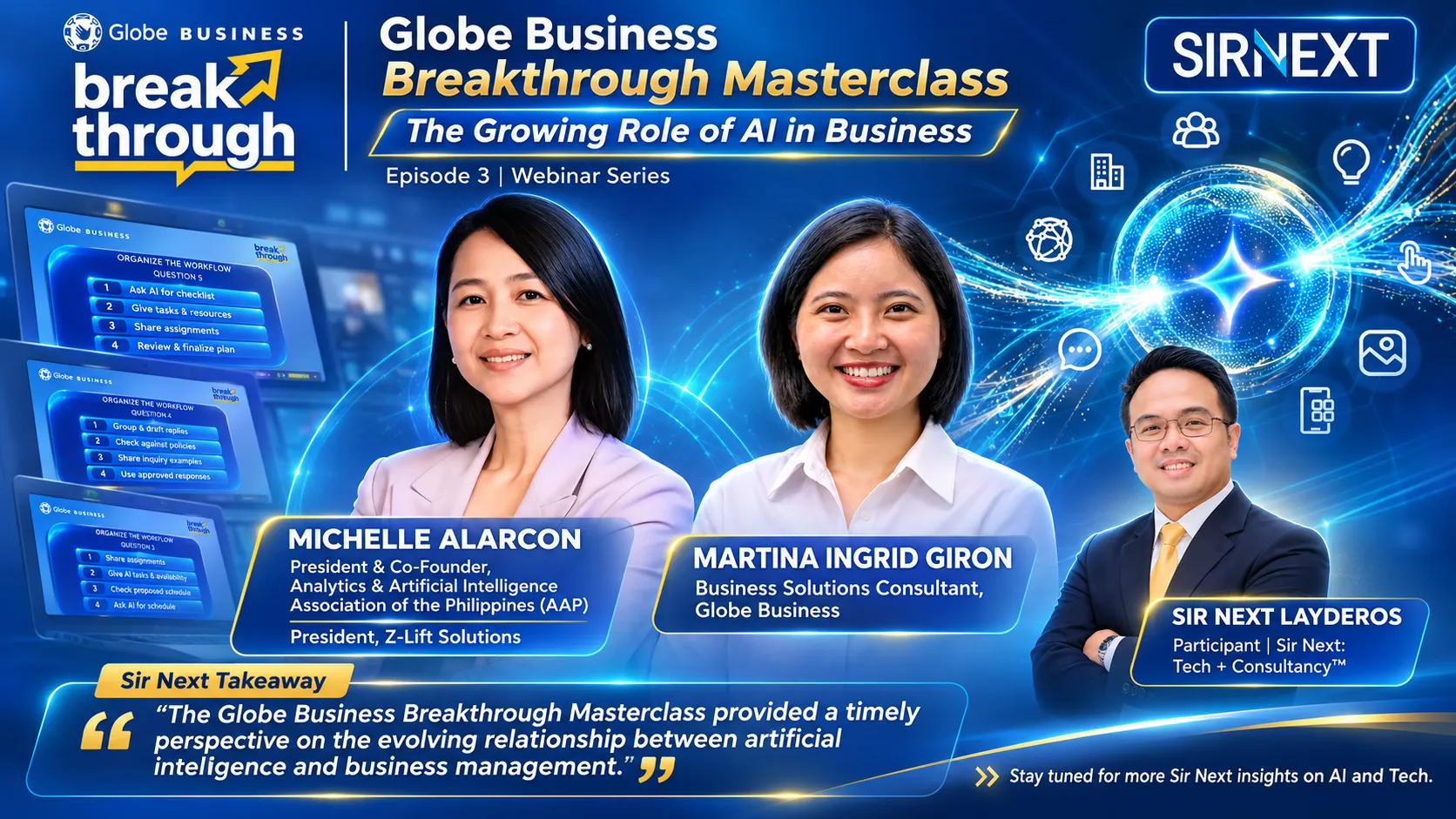
The final episode concluded with a reiteration that artificial intelligence should support business operations rather than replace the people responsible for them.
Participants were encouraged to identify at least one operational challenge or workflow that they could examine more closely in their own organizations.
The event also included participant engagement activities and a raffle featuring four ₱1,000 GCash prizes and one ₱2,000 prize.
Globe Business announced holiday connectivity offers available until December 31, 2026, including additional 5G mobile data benefits for eligible mobile plans and selected GFiber Biz broadband offers.

The announcements underscored the importance of reliable connectivity as part of a broader digital transformation ecosystem.
With the conclusion of Episode 3, Globe Business officially closed its three-part Breakthrough Masterclass series, encouraging entrepreneurs to continue exploring practical, responsible, and sustainable applications of artificial intelligence.
Sir Next's Takeaways: Seven Lessons on the Growing Role of AI in Business
Having participated in the masterclass, I believe the most significant learning opportunities extend beyond the technical capabilities demonstrated.
They address a broader transformation in how businesses approach strategy, operations, leadership, organizational learning, and value creation.
1. AI Adoption Must Begin With Business Strategy, Not Technology
The first question business leaders should ask is not which AI platform they should subscribe to.
It is which business problem they need to solve.
Artificial intelligence is a strategic enabler. Its implementation should be connected to identifiable operational challenges, measurable objectives, and business priorities.
A technically impressive AI solution that addresses an insignificant problem may deliver less value than a simple AI-assisted process that resolves a critical business bottleneck.
Start with the pain point. Define the desired outcome. Select the appropriate technology.
2. AI Capability Must Move Beyond the Individual
An organization should not become dependent on its most technically capable employee.
When AI knowledge remains concentrated within one person, the business creates another form of operational dependency.
Organizations must transform individual knowledge into shared prompts, verified information, standardized procedures, and transferable competencies.
The real opportunity is not simply to create AI-powered individuals but to develop AI-capable organizations.
3. Data Governance Is the Foundation of Reliable AI
AI cannot consistently compensate for inaccurate information, conflicting records, outdated documents, or unclear business definitions.
Before organizations automate decisions, they must establish reliable data.
Before they connect AI to multiple systems, they must understand which information sources are authoritative.
A single source of truth, data ownership, standardized business terminology, appropriate access permissions, and sustainable data pipelines are not optional technical considerations.
They are essential management disciplines.
4. Agentic AI Is Shifting Businesses From Assistance to Execution
Generative AI introduced new possibilities for individual productivity.
Agentic AI expands those possibilities into connected workflows, specialized agents, application orchestration, and scheduled operational execution.
The emerging opportunity for businesses is to move beyond repeatedly prompting AI toward developing well-defined systems that can support recurring organizational activities.
However, successful agentic AI implementation requires more than connecting applications.
It requires process architecture, clearly defined business rules, reliable data, testing, appropriate permissions, and continuous human oversight.
The technology can build an agent. Leadership must design the system behind it.
5. Responsible AI Governance Enables Sustainable Growth
AI governance should not be viewed as a barrier to innovation.
It is a mechanism for protecting trust, accountability, and organizational sustainability.
Michelle Alarcon's Six AI House Rules demonstrate that even SMEs can begin establishing meaningful governance without requiring unnecessarily complicated frameworks.
Businesses must clearly define what AI may do, what information it may access, which decisions require approval, who reviews its outputs, and how errors are corrected.
The more autonomy an organization delegates to technology, the more important its governance responsibilities become.
Delegate tasks, not accountability.
6. AI Maturity Must Be Measured Through Business Value
This is particularly relevant to the question I raised during the masterclass.
AI maturity cannot be reduced to the number of subscriptions purchased, prompts generated, hours saved, or employees using artificial intelligence.
Organizations must examine whether AI is contributing to improved decision-making, stronger operational capabilities, better customer experiences, reduced organizational dependency, appropriate risk management, and sustainable business outcomes.
Time savings and cost reductions remain important, but they represent only part of the value equation.
The real measure of AI maturity is whether an organization can consistently translate technological capability into responsible strategic value.
7. The Future of AI Must Remain Human-Led
The most important takeaway from the entire masterclass is that technology should enable people to perform more meaningful work.
Artificial intelligence can retrieve information, identify patterns, recommend alternatives, prepare communications, coordinate applications, and support operational execution.
But leadership remains responsible for strategy, judgment, empathy, relationships, ethics, and accountability.
The ultimate objective of AI adoption should not be to create businesses without people.
It should be to create organizations where people are no longer unnecessarily burdened by repetitive activities and are empowered to focus on what matters most.
Automate the repetitive. Empower the people. Protect the relationships. Strengthen the organization.
Final Thoughts: Building Intelligent Organizations, Not Just AI-Powered Businesses
The Globe Business Breakthrough Masterclass provided a timely perspective on the evolving relationship between artificial intelligence and business management.
For Philippine SMEs, the future of AI adoption is not necessarily dependent on acquiring the most sophisticated technology or implementing the largest digital transformation program.
It begins with understanding business challenges, organizing information, standardizing workflows, developing people, establishing governance, and identifying measurable opportunities for value creation.
The transition from generative AI to agentic AI represents an important development in enterprise technology.
However, technological maturity must be accompanied by organizational maturity.
Businesses must learn to balance automation with accountability, efficiency with effectiveness, innovation with governance, and intelligence with human judgment.
As a strategist, technology consultant, and advocate of responsible digital transformation, I believe artificial intelligence offers businesses an extraordinary opportunity to rethink how they operate and create value.
But the responsibility of shaping that future remains with us.
AI accelerates intelligence. Human judgment determines direction. Leadership remains accountable for outcomes.
My appreciation to Globe Business, Andrea Tesorero, Michelle Alarcon, Martina Ingrid Giron, and host Sonja Calit for facilitating a meaningful and practical learning experience for Philippine entrepreneurs and business leaders.
The conversations initiated through this masterclass should continue beyond the webinar.
They should find their way into boardroom discussions, management meetings, employee development programs, strategic planning initiatives, and the everyday decisions that shape the future of our businesses.
AI-powered. Human-led. Strategy-driven. Governance-enabled. Purpose-centered.
Stay tuned for more Sir Next insights on AI and Tech, as we continue exploring the intersection of emerging technologies, strategic management, responsible innovation, and business transformation.
Visit www.sirnext.com for more technology insights, thought leadership articles, professional learning experiences, and strategic perspectives.
Sir Next: Tech + Consultancy™
To God be the glory.
Editorial note: This article is an independent event feature and personal learning reflection based on the November 26, 2026 Globe Business Breakthrough Masterclass. Speaker discussions have been summarized and organized for clarity. Additional strategic management frameworks and proposed performance indicators represent the author's analytical interpretations and are not official Globe Business or AAP frameworks. Demonstrated technology capabilities may depend on product configuration, licensing, permissions, and deployment conditions.
Loading comments…