
Sir Next · NEXT5
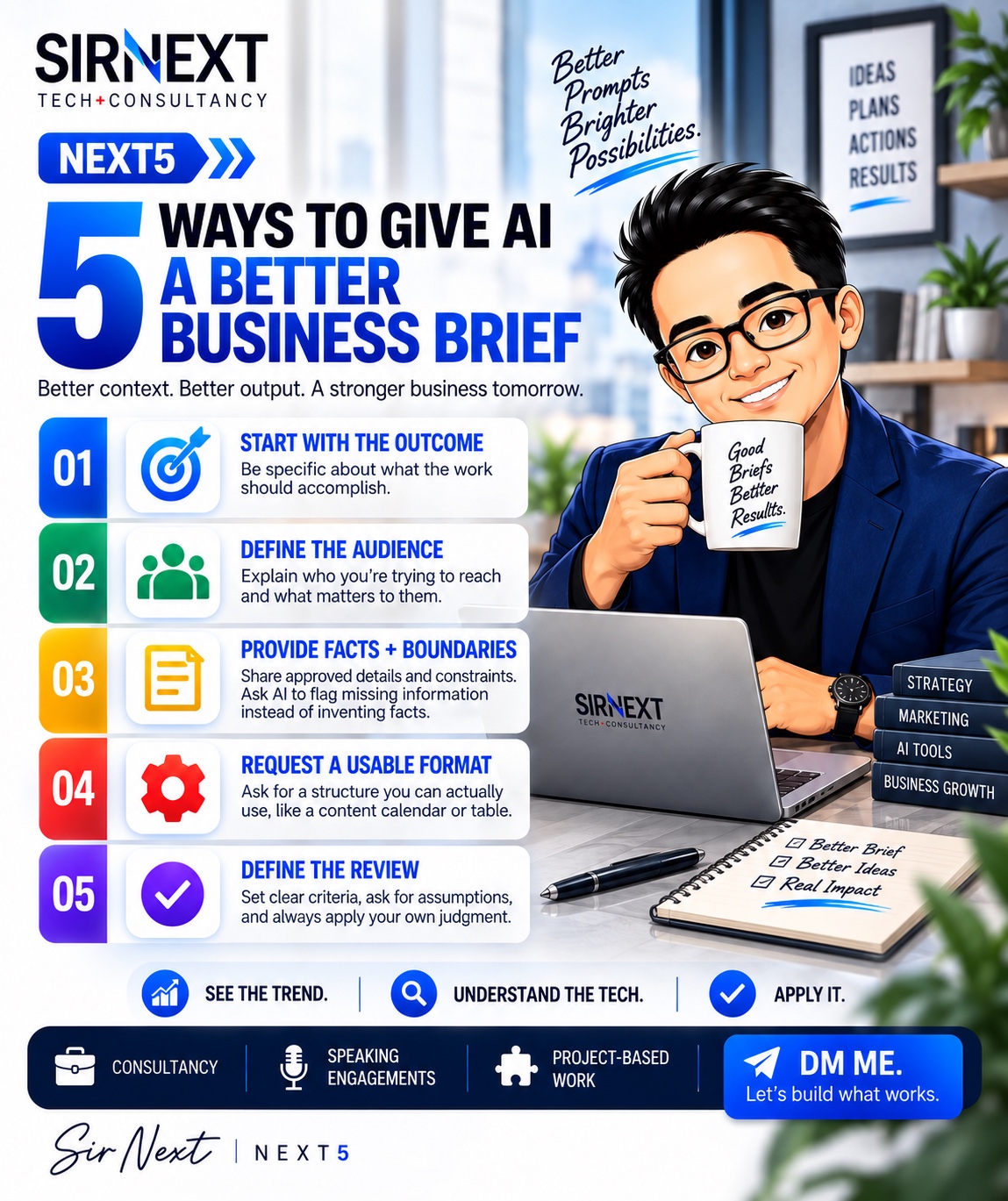
5 Ways to Give AI a Better Business Brief
When AI gives you a generic marketing plan, a weak caption, or an unrealistic business idea, look at the brief as well as the output. “Create a marketing plan” leaves important decisions unexplained. A clearer business brief gives the tool something more useful to work with.
For entrepreneurs and MSMEs, practical use of artificial intelligence begins with explaining the business problem. What are you trying to achieve? Who is the customer? Which facts are approved, and what limits must the work respect?
You can improve those instructions without becoming a prompt engineer. Here are my NEXT5 for giving AI a brief your team can review and use.
1. Start with the business outcome
Begin with what the work needs to accomplish. “Make a marketing plan” names a deliverable but gives little direction. Try a more specific request:
“Create a one-week Facebook content plan for a neighborhood bakery introducing a breakfast bundle. The objective is to generate inquiries and encourage morning store visits.”
The tool now has a business, a channel, a timeframe, an offer, and a purpose. You also have a basis for evaluating the result: does each proposed post help customers understand the bundle or take a useful next step?
2. Explain who you want to reach
Give AI the customer context you actually know. Working parents buying breakfast may care about convenience, price, speed, and availability. Customers ordering celebration cakes may need details about customization, presentation, and advance ordering.
Those situations call for different messages. Include relevant customer questions, buying circumstances, and preferred language where you have evidence. Separate those observations from assumptions you still need to test.
Do not ask the tool to treat an imagined customer profile as research. Better context helps make marketing more relevant, but it does not replace listening to customers.
3. Provide approved facts and clear boundaries
Supply the information the output must respect: product details, prices, location, available channels, budget, promotion period, and brand guidelines. A useful brief tells AI both what it can use and what remains unknown.
Ask it to flag missing information rather than invent a price, testimonial, statistic, product feature, or customer claim. If a delivery fee is still undecided, the draft should identify that gap instead of quietly promising free delivery.
Share only information you are authorized to use, and remove unnecessary personal customer details. Think of AI as a fast collaborator that still needs appropriate source material.
4. Request a format your team can use
“Give me ideas” can produce a long answer that is difficult to act on. Specify the structure you need. For a content calendar, request columns for Customer Question, Key Message, Content Format, Visual Idea, and Call to Action.
For a campaign outline, you might prefer Objective, Audience, Channel, Content Idea, and KPI—the measure you will use to assess progress. Match that measure to the objective; inquiries and store visits are different outcomes from reach.
A clear format makes it easier to spot missing details, assign work, and discuss revisions. The output should fit the process your business can actually run.
5. Define what “good” means, then review it yourself
Before generating the work, specify your review criteria: accurate information, a clear offer, a suitable brand voice, audience relevance, a practical next action, and claims you can support.
Ask AI to list its assumptions separately. Then check the output against your approved facts and read it as a customer would. Does it make sense? Does it sound like your business? Could your team deliver what it promises?
Revise the weak parts with specific feedback. An instruction to avoid invented facts is helpful, but it is not a guarantee of accuracy. Human review remains part of the job.
A simple Sir Next AI brief
Adapt this to the task and replace every bracketed field with your actual information:
Create [deliverable] for [business], aimed at [audience]. Our objective is [outcome].
Use only these approved facts: [facts]. Work within these constraints: [budget, channel, tone, and timeline].
Present the output as [format]. Check it against [review criteria]. Identify missing information and assumptions separately. Do not invent facts.
Apply your judgment before using the result. The aim is better business decisions and marketing execution. To put the brief into a weekly routine, explore 5 Content Habits That Help Small Businesses Stay Consistent.
See the trend. Understand the tech. Apply it.
Further reading
Google’s prompt design strategies explain clear instructions, context, constraints, response formats, and iterative refinement. The business examples and five-part brief above are Sir Next’s practical application of these ideas.
Build practical AI workflows
Want to help your team move from random prompting to a repeatable workflow? DM Sir Next for consultancy, speaking engagements, or project-based work. Let’s build AI workflows that work for your business.