
Sir Next · NEXT5
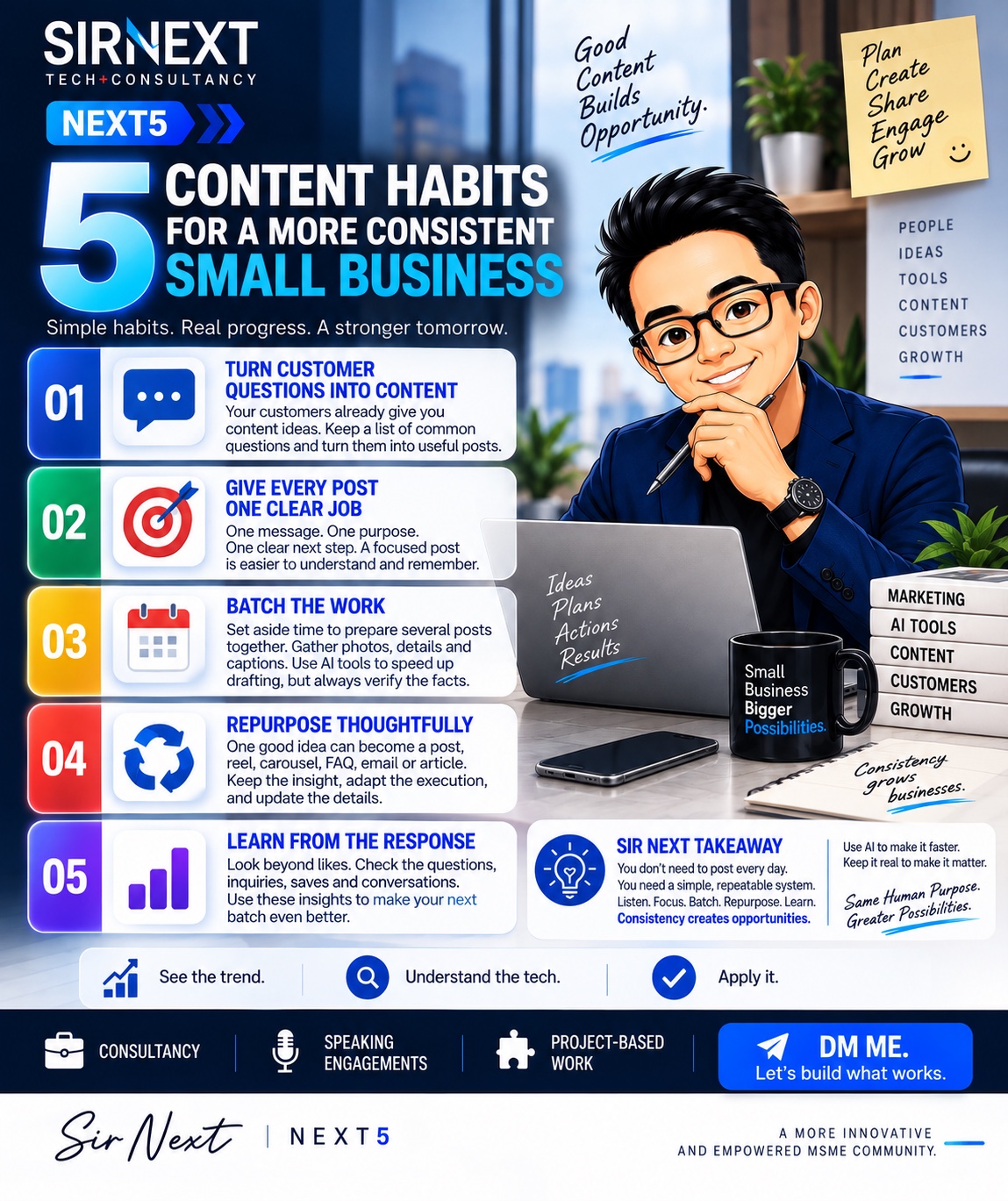
5 Content Habits That Help Small Businesses Stay Consistent
For many small businesses, the challenge with content marketing is consistency. You post when there is a promotion, disappear when operations get busy, and return when you need customers again. A simpler, repeatable system can help you show up with useful content more regularly.
For Filipino micro, small, and medium enterprises (MSMEs), that pattern is understandable. You are managing customers, inventory, suppliers, finances, and often social media too. Your content plan needs to fit the business you actually run.
Artificial intelligence (AI) can help with preparation, but the direction should come from your customers and your experience. Here are my NEXT5 for a content routine you can maintain.
1. Turn customer questions into content
Your customers are already giving you ideas. “How do I order?” “Do you deliver?” “Which product is right for me?” Keep a simple list of the questions that appear repeatedly in messages, calls, and store conversations.
Each question can become a social post, short video, FAQ, graphic, or website article. A bakery asked about advance orders could explain its ordering process; a service business could clarify what a package includes.
Listen first. Then use AI to group the questions into themes or prepare a first draft. Remove names and other identifying details before sharing customer conversations with a tool or using them publicly.
2. Give every post one clear job
A post that combines a new product, a promotion, store hours, your company story, and an inspirational quote can leave readers unsure what matters. Before writing, ask: What should someone know, feel, or do after seeing this?
A product post can explain one benefit. An educational post can answer one question. A promotional post can encourage an inquiry. A customer story or a look behind the scenes can build trust.
Choose one primary purpose and one clear next step. For example: “Message us with your preferred pickup date.” Make the action easy to understand and realistic for your team to handle.
3. Batch the work, with time for review
You do not have to create content every day. Set aside a manageable block of time each week to gather photos, confirm product details, draft captions, and prepare several posts together.
AI can help brainstorm angles, shorten a caption, or adapt a draft for another channel. Give it approved information and a clear business brief so you spend less time correcting avoidable gaps.
Before scheduling anything, verify prices, inventory, dates, links, and offers. Leave room to update scheduled posts when circumstances change. AI can accelerate preparation; the business owner still needs to approve the facts.
4. Repurpose ideas thoughtfully
One useful answer can support several formats. A customer question about choosing the right product could become a Facebook explanation, a short demonstration video, a carousel comparing options, and a website FAQ.
Keep the central insight and adapt the execution. A video needs something worth showing. A carousel needs a clear sequence. A website article can explain the details that a short caption cannot.
Ask AI to suggest those adaptations, then review whether each suits the channel. Recheck older prices, dates, links, and offer details before reusing them. Repurposing works best when the information remains useful and current.
5. Learn from the audience’s response
Publishing starts the learning process. Notice what people ask, which details confuse them, and whether they click, message, inquire, save, or share. Compare that response with the job you gave the post.
You can begin with page insights and a simple weekly record of inquiries. A post with modest likes might still generate useful conversations; a popular post might not produce the action you intended.
AI can summarize larger sets of feedback, but the interpretation needs business context. Look for what helped people understand your offer, trust your business, or take the next step.
Further reading
This NEXT5 framework and its small-business examples are Sir Next’s practical guidance. For website content, Google’s people-first content guidance provides further questions for assessing usefulness and original value.
Build a smarter content system
Exploring how digital marketing and AI can make your content workflow more practical? DM Sir Next to discuss consultancy, speaking engagements, or project-based work. Let’s build what works.
Continue reading: 5 Ways Small Businesses Can Use AI Today.