
NextREVIEW · Science fiction · Technology & judgment
Minority Report (2002): A film that feels more relevant in the age of AI
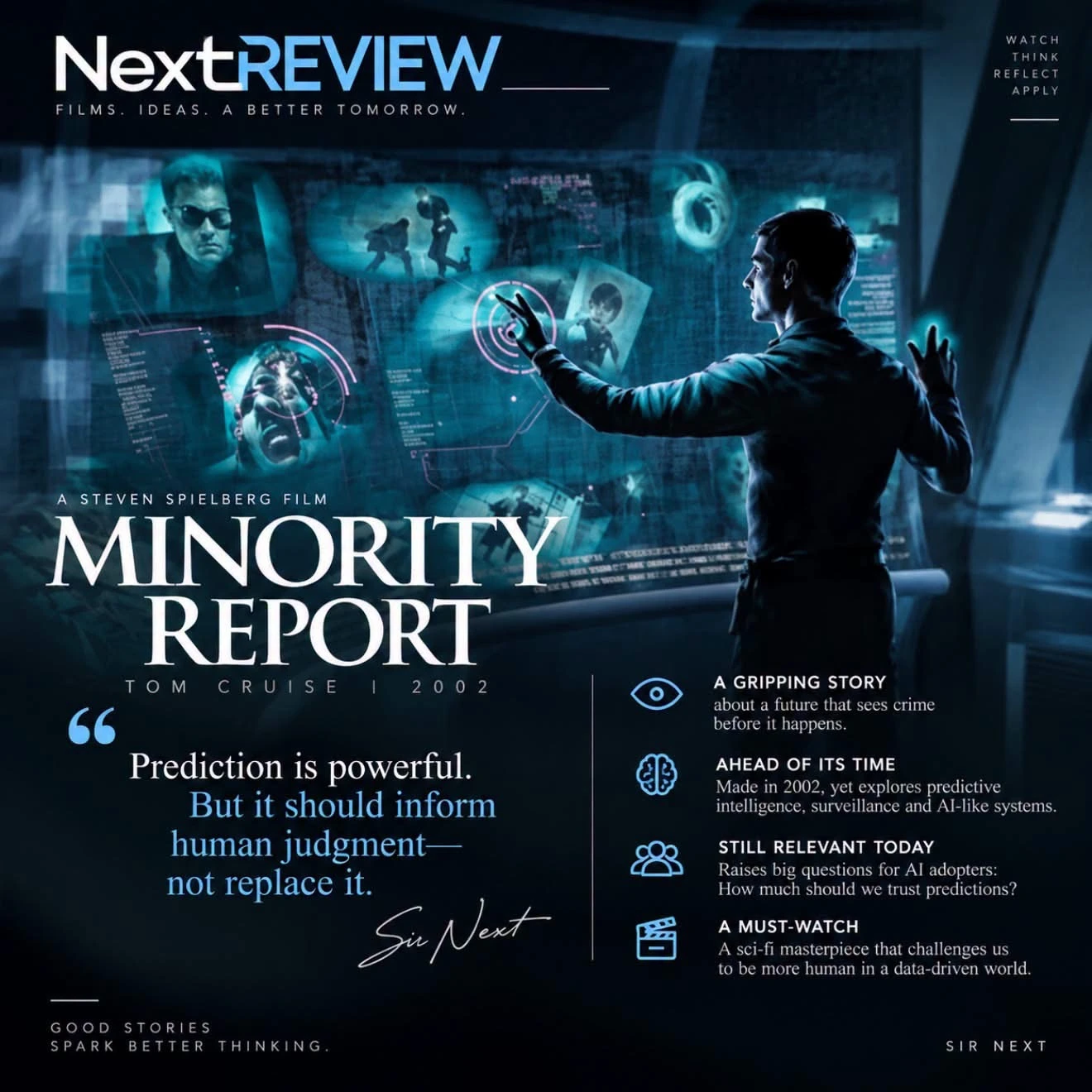
I finished watching Minority Report, starring Tom Cruise and directed by Steven Spielberg, thinking: grabe, this film was released in 2002. Yet many of its questions feel close to the decisions we are making about technology today.
The story
John Anderton, played by Cruise, works for PreCrime, a system that identifies murders before they happen through the visions of three Precogs. It seems almost perfect—until Anderton himself is predicted to commit a murder.
The premise quickly becomes a question about power. When a system claims to know what you will do, how much room remains for your choices? And who can challenge the system when it is wrong?
The cast
Director: Steven Spielberg
- Tom Cruise — John Anderton
- Colin Farrell — Danny Witwer
- Samantha Morton — Agatha
- Max von Sydow — Lamar Burgess
- Lois Smith — Dr. Iris Hineman
Insights for work and life
Watching it in the age of AI
The Precogs are fictional beings with precognitive abilities; they are not AI. The connection I see is in the confidence people place in a system that predicts human behavior, and the authority they allow it to exercise.
The film imagines biometric identification, personalized advertising, extensive surveillance, and gesture-based computing. Watching it in 2026, those images invite reflection on how technology shapes what people see, how they are classified, and what decisions are made about them.
For marketers, the personalized advertising is especially striking. Relevance can be useful, but the film makes it feel intrusive too. It raises a question worth carrying into our work: just because we can recognize or predict something about a person, what should we do with that information?
The risk of unquestioning trust
For me, the film’s strongest warning is about treating a powerful system as if it cannot be wrong. A prediction can look convincing while the assumptions behind it remain hidden or incomplete.
That is a useful lens for leaders and AI adopters. Before acting on a recommendation, we should ask what supports it, what it may have missed, and how a person affected by the decision could challenge it. The more serious the consequence, the more carefully those questions deserve to be answered.
Human responsibility stays with us
Technology can support judgment. Responsibility still belongs to the people choosing how it is used. Delegating analysis should not become a way of avoiding accountability for an outcome.
This is why Minority Report feels so relevant to me. Its futuristic setting brings a human concern into focus: whether we are willing to question certainty when an institution or system presents it as unquestionable.
Prediction is powerful. It should inform human judgment while preserving human agency.
From a Christian perspective
The film’s fictional Precogs are not a picture of biblical prophecy. My Christian reflection is about our own limits: human systems and leaders can make mistakes, and certainty deserves scrutiny.
Micah 6:8 connects justice with mercy and humility before God. For me, that means listening to evidence, resisting unfair judgments, and remembering the dignity of the person affected by a decision. Accountability should include the institutions making those decisions.
A line to reflect on
“You still have a choice.”
— Agatha (Samantha Morton)
A confident prediction does not remove our responsibility to choose wisely. For me, this line is a reminder to question assumptions and leave room for a person to change.
The Sir Next takeaway
The question I carry from this film is not only how intelligent our machines can become, but how wisely we will use the intelligence available to us.
Twenty-four years after its release, Minority Report still feels urgent. Parang mas naiintindihan pa natin ngayon ang warning nito. For leaders, marketers, entrepreneurs, and anyone seriously adopting AI, it deserves another watch.
When a system gives us a prediction, will we still make room for evidence, uncertainty, and a person’s capacity to choose?
Final verdict & score
9/10 — Outstanding. An absorbing science-fiction thriller whose questions about surveillance, freedom, and institutional power remain worth debating. Its bleak tone and complex plotting demand attention, but the combination of suspense and ideas earns a strong recommendation.
Rotten Tomatoes reference
View Minority Report (2002) on Rotten Tomatoes for cast, film details, critics’ reviews, and current audience and critic scores.
Rotten Tomatoes percentages indicate the share of positive reviews or ratings. They are separate from the NextREVIEW score out of 10 and can change over time.
What did you think?
React anonymously. No sign-in needed.
Loading reactions…
Share on Facebook