
Sir Next · NEXT5
5 Tasks You Should Stop Doing Manually in 2026
Busy does not always mean productive. Repeated copying, summarizing, and coordinating can crowd out the work that needs your attention most. These five tasks are candidates for assistance or automation, provided the process is clear and the output remains reviewable.
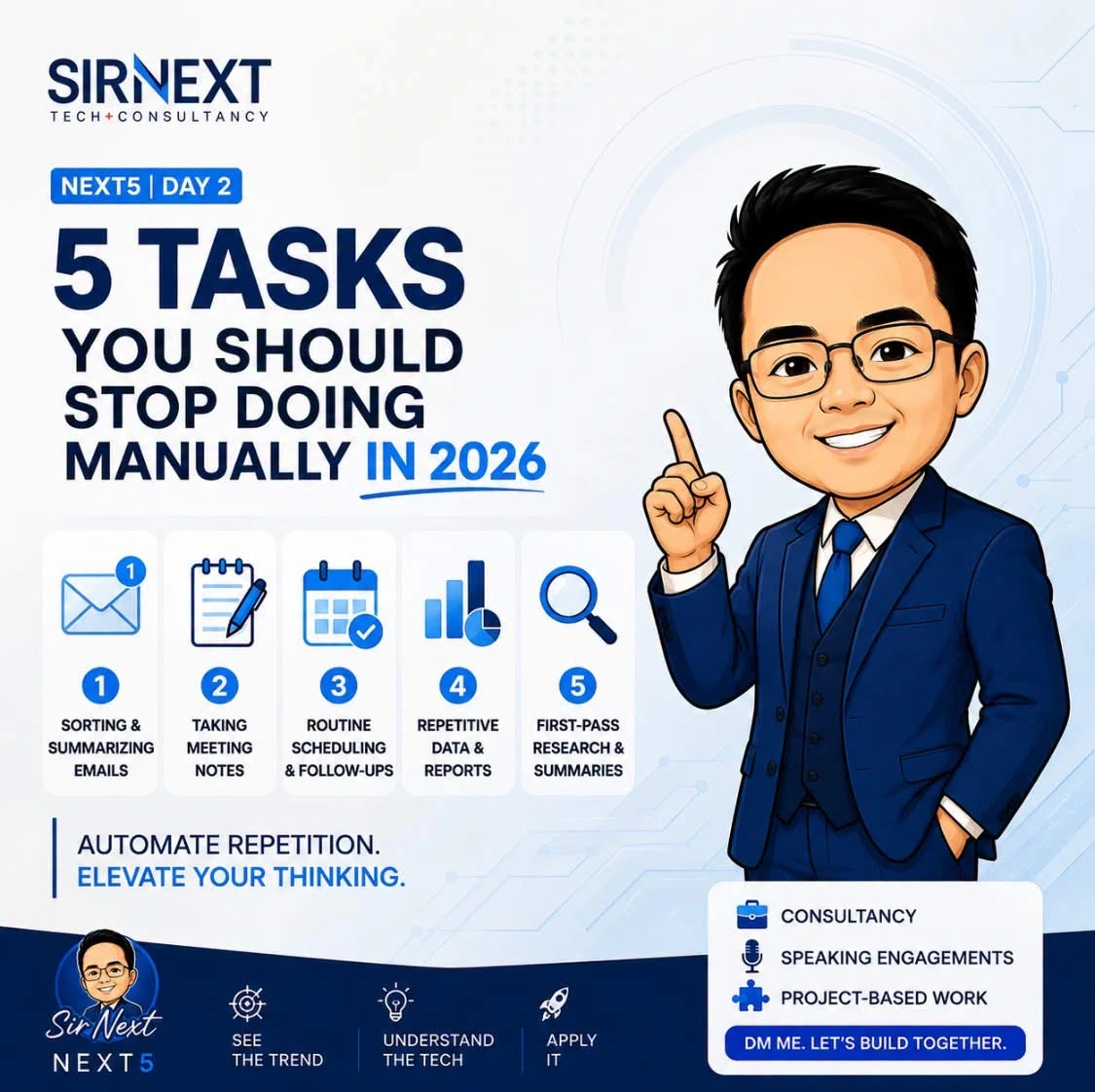
1. Sorting and summarizing emails
Use available email rules and AI assistance to group routine messages, summarize long threads, and surface possible action items. Rules can handle predictable sorting; AI can help interpret less structured text.
Start with one folder or recurring project. Check that a summary preserves the latest decision, deadline, and responsible person. Keep consequential replies under your control, especially when a thread includes changing instructions or commitments.
2. Taking meeting notes
Tools such as Fireflies.ai and supported Zoom features can help capture and summarize discussions. Let participants know when recording or transcription is being used, and follow the organization’s requirements.
After a meeting, review names, decisions, action owners, and dates. A confident summary may confuse a proposal with an agreement. The useful deliverable is an accurate action list that participants can confirm.
3. Routine scheduling and follow-ups
Booking links, calendar rules, and workflow tools can reduce repeated coordination. Some scheduling tasks need no generative AI at all.
Set your working hours, time zone, buffer time, and cancellation process before automating. For follow-ups, define when the sequence stops—for example, when someone replies or books. Use automation to support relationships rather than continue messaging after the context has changed.
4. Repetitive data and reports
A repeatable report often benefits from spreadsheet formulas, a template, or an integration before it needs AI. Add AI where a first-pass explanation or categorization would be useful.
Keep a clear connection to the underlying data. Check totals, reporting periods, definitions, and missing records before sharing the result. If the input format changes, the workflow needs review. A faster process that repeatedly reproduces an error is not an improvement.
5. First-pass research and summaries
AI can help organize sources, compare initial findings, and identify unanswered questions. Give it a defined topic, date range, and preferred source types.
Ask it to distinguish what a source states from its own interpretation. Open original documents before relying on key claims, especially prices, policies, specifications, or statistics. Use the initial summary to decide where deeper investigation is needed rather than treating it as the end of research.
Sources & further reading
Original product documentation and research. Reviewed 21 September 2026. Practical examples and recommendations are Sir Next’s editorial guidance.
Explore practical applications of AI and digital marketing through consultancy, speaking engagements, and project-based work with Sir Next.