
Sir Next · NEXT5
5 Google Tools Professionals Are Underusing
Most professionals already know Gmail, Search, Drive, Docs, and Meet. Familiarity, however, can hide useful features. These are five tools I encourage professionals to explore more deeply, especially when research and marketing work feel fragmented.
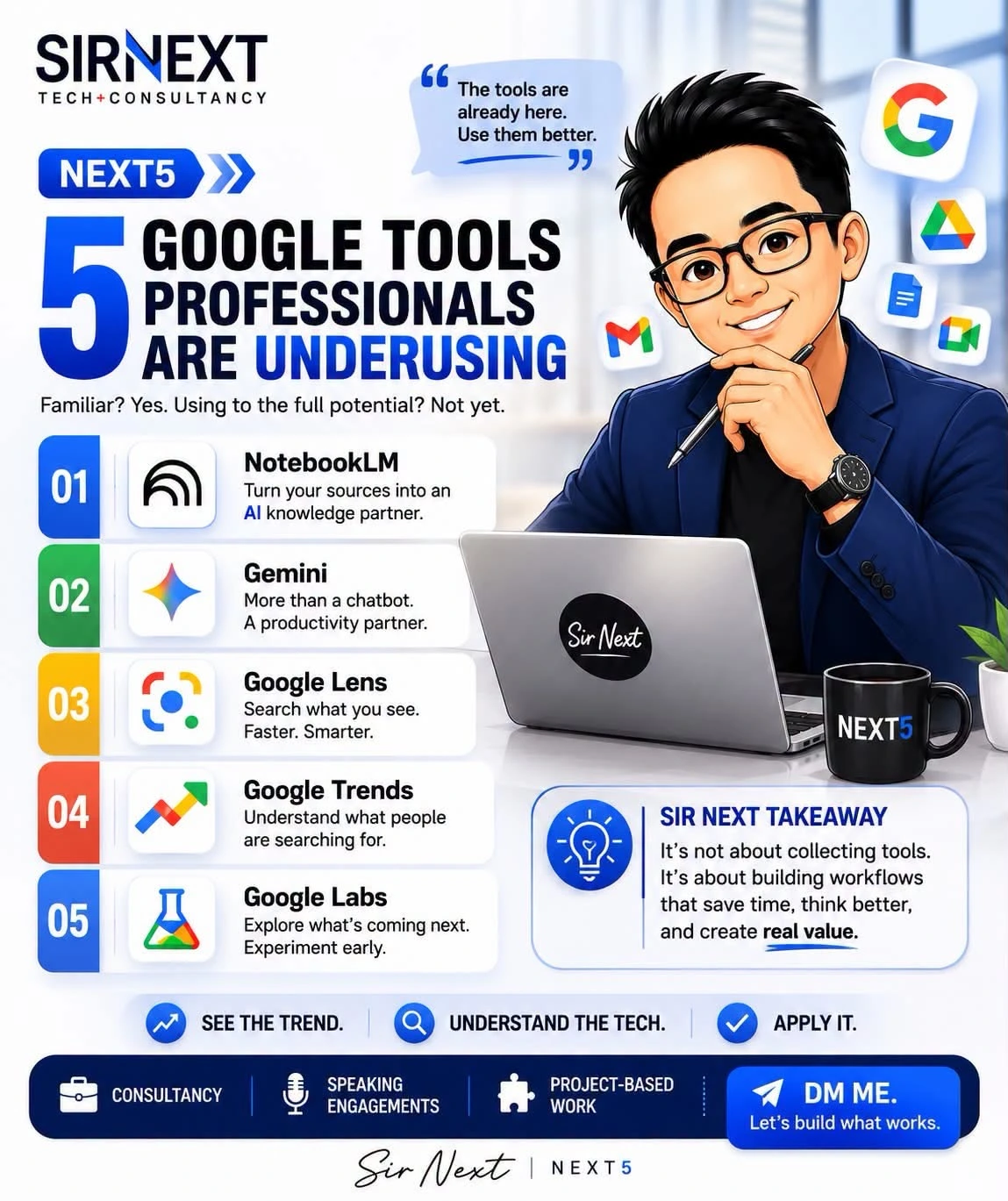
1. NotebookLM: give your research a source base
NotebookLM helps you work with supplied sources such as PDFs, websites, and documents. Google also now refers to this product as Gemini Notebook; the accompanying artcard uses the NotebookLM name.
Try building a notebook for a client briefing with approved product information and research. Ask for recurring themes and supporting references, then open the cited passages yourself. Source-grounded answers remain dependent on the quality and completeness of the material you provide.
2. Gemini: make brainstorming part of a process
Gemini’s Deep Research guidance describes research using Search and other supported sources. Beyond asking questions, use Gemini to develop options and organize an initial analysis.
For example, ask for three campaign directions based on your actual audience, offer, budget, and channel. Compare the assumptions behind each. Keep your customer evidence close so plausible suggestions do not become unsupported strategy.
3. Google Lens: search what you see
Google Lens lets you search through images and can help with visual identification and translation. It is useful when describing something in a search box would take longer than showing it.
At a trade fair, you might research an unfamiliar product category or translate visible text. Treat visual matches as leads to investigate; similar-looking packaging does not establish that products or suppliers are the same.
4. Google Trends: test your assumptions about interest
Google explains that Trends uses sampled, normalized search data. Its 0–100 scale represents relative interest, not absolute search volume, sales, or market share.
Compare relevant topics across the same location and period. A Philippine business could investigate seasonal interest before planning content, then compare that signal with actual inquiries and sales. Search curiosity alone does not prove purchase intent.
5. Google Labs: experiment with a purpose
Google Labs showcases experimental AI experiences. Availability and functionality can change, so treat it as a place to learn and test.
Choose one experiment and give it a specific task. Ask whether it improves your existing process enough to justify learning it. Avoid building a critical customer workflow around an experiment without considering how you would continue if it changed.
Sources & further reading
Original product documentation and research. Reviewed 21 September 2026. Practical examples and recommendations are Sir Next’s editorial guidance.
Explore practical applications of AI and digital marketing through consultancy, speaking engagements, and project-based work with Sir Next.