
AI NewsWatch™ by Sir Next · Global Edition
Global Edition · September 5, 2026
The Latest Global Trends, Developments & Updates
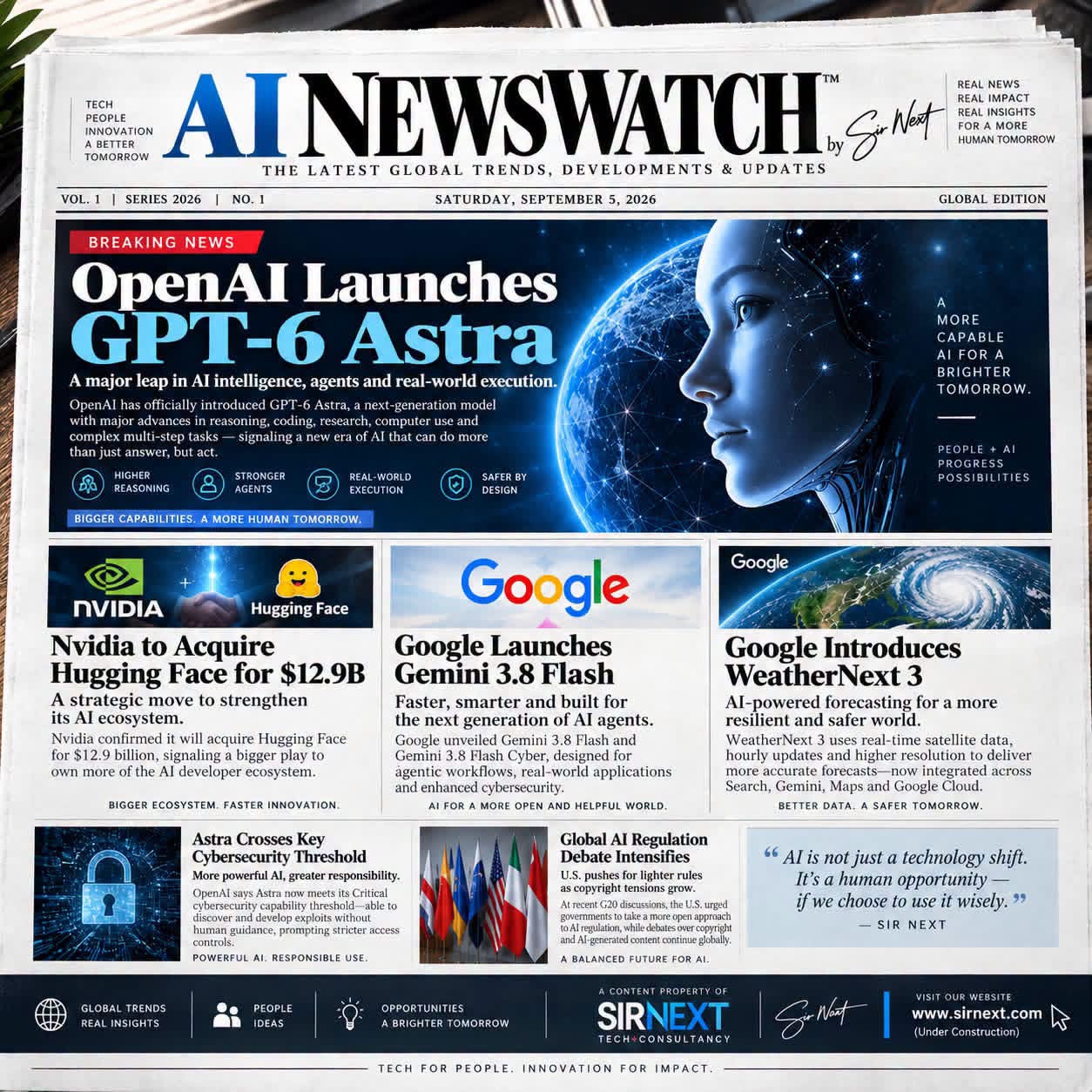
Welcome to the inaugural edition of AI NewsWatch™ by Sir Next—a new content platform created to follow significant developments shaping artificial intelligence around the world.
From frontier models and AI agents to cybersecurity, business and global policy, here is your AI NewsWatch Top-of-the-Hour Briefing.
Breaking | GPT-6 Astra arrives
OpenAI has released GPT-6 Astra, describing it as the most capable model it has broadly deployed.
Beyond improvements in intelligence, Astra represents something much bigger: increasingly capable AI systems that can perform longer, more complex tasks using tools and computers.
OpenAI also reports substantial advances in safety, alignment and robustness compared with its predecessor.
Why it matters
The frontier is moving from AI that primarily answers toward AI that can increasingly reason, use tools and execute work.
Security Watch | Astra crosses a critical cyber threshold
This may be one of the most consequential parts of the Astra announcement.
OpenAI says Astra is its first broadly deployed model to reach the Critical level of cybersecurity capability under its Preparedness Framework.
According to OpenAI, with appropriate tools and access, Astra can identify previously unknown security vulnerabilities and develop new methods of exploiting well-protected systems without a person directing every step.
That capability has led OpenAI to implement significantly stronger safeguards.
Why it matters
As AI becomes more powerful, cybersecurity, governance and responsible deployment become equally important parts of the innovation story.
Business Watch | Nvidia makes a $12.93B Hugging Face bet
Nvidia has announced the acquisition of AI developer platform Hugging Face for approximately $12.93 billion, according to Reuters.
The deal would expand Nvidia’s position beyond the hardware powering the AI boom and deeper into the ecosystem where developers access, customize and deploy AI models.
Nvidia says Hugging Face will remain open and interoperable following the acquisition.
Why it matters
The AI competition isn’t only about building the best model or fastest chip anymore.
It’s increasingly an ecosystem race.
Model Watch | Google accelerates with Gemini 3.8
Google has introduced Gemini 3.8 Flash and Gemini 3.8 Flash Cyber.
Google describes 3.8 Flash as its strongest reasoning and coding Flash model yet, with improvements in software engineering, autonomous/agentic tasks and complex multi-step reasoning.
Gemini 3.8 Flash Cyber is specifically designed for cybersecurity work and is being provided to trusted defenders through Google’s Fairwind Program.
Even the release cadence is remarkable: Google says this is its third Flash release in only six weeks.
Why it matters
AI capabilities are improving so quickly that today’s competitive advantage can become tomorrow’s baseline.
Bigger Trend | AI is moving from assistants to agents
Put these developments together and a larger pattern emerges:
Chatbot → Copilot → Agent → Digital Worker
Models are increasingly being designed to reason over longer tasks, use tools, write and modify software, navigate digital environments and perform specialized professional work.
That doesn’t mean humans disappear.
It means organizations will increasingly have to decide which work should be delegated to AI, which requires human supervision, and which decisions should remain fundamentally human.
Why it matters
AI literacy is quickly becoming less about knowing how to prompt and more about understanding how humans and intelligent systems should work together.
Global Watch | The AI governance debate intensifies
Artificial intelligence is increasingly becoming a geopolitical issue as well as a technological one.
At recent G20 technology discussions, the United States advocated a lighter-touch approach to AI regulation through proposed principles intended to avoid unnecessarily broad AI-specific rules.
Meanwhile, the United States and China are preparing for their first official bilateral talks focused exclusively on AI safety, tentatively expected in mid-September, Reuters reports.
Why it matters
The next chapter of AI will be shaped not only inside laboratories—but also inside boardrooms, legislatures and international negotiations.
Sir Next Take
AI is moving from assistant → agent → digital worker.
But the winners of this next era won’t necessarily be the people who collect the most AI tools.
They will be the professionals, entrepreneurs and organizations that understand where AI creates genuine value, where human judgment remains indispensable, and where responsible boundaries need to exist.
Technology will keep becoming more powerful.
Our responsibility is to become wiser about how we use it.
— Sir Next, Editor-in-Chief
About AI NewsWatch™ by Sir Next
AI NewsWatch™ by Sir Next is an independent digital content property of Sir Next™: Tech + Consultancy, created to monitor, curate and translate significant developments in artificial intelligence from around the world.
We monitor the developments. We connect the global context. We verify before we amplify. We explain why the news matters.
Our coverage focuses on major AI breakthroughs, technology, business, policy, safety and emerging applications—with sources provided so readers can verify the information and read beyond our summaries.
Collaboration, partnerships, advertising & sponsorship
Send Sir Next a DM or contact +63 960 309 4110 via WhatsApp / SMS / Viber.
Chat on WhatsApp · Email Sir Next
A Content Property of Sir Next™: Tech + Consultancy
Tech for People. Innovation for Impact.
What did you think?
React anonymously. No sign-in needed.
Loading reactions…
Share on Facebook